
IIntroduction
The aim of this paper is to explore how sociopolitical context in the United States, France, and Hong Kong has shaped feminist filmmaking, and how these varied feminist ideas are received and reinterpreted by Chinese audiences.
This essay examines the intersection of film, feminism, and cultural context through three films: Greta Gerwig’s Barbie (US, 2023), Céline Sciamma’s Portrait of a Lady on Fire (France, 2019), and Ann Hui’s Night and Fog (Hong Kong, 2009). Gerwig, an American writer and director famous for female-centered narratives, uses humor together with the commercial language of Hollywood to satirize patriarchy and the long-standing expectations imposed on women. Sciamma, a French director whose work focuses on female identity, queer identity, and desire, constructs an ideal world away from “male gaze”, delicately depicting how two women look, help, and love each other. Ann Hui—a key figure of the Hong Kong New Wave—explores how women express themselves – or endure in silence – in ordinary scenes of daily life, together with larger social issues like immigration and family structures. Although these three films differ in theme, genre, and cinematic form, the differences offer a useful entry point for exploring how feminism manifests distinct cinematic forms in different cultural contexts.
Despite my own Chinese nationality, mainland China is not considered as a fourth context in this paper, because it has a more strictly regulated film industry. Films must pass state review for public release and works that relate to gender, sexuality, or other socially sensitive issues may have to negotiate and adjust many times to meet exhibition limits. Although more female filmmakers have entered the Chinese film industry in recent decades, women remain underrepresented in many major creative and decision-making positions. Therefore, this paper treats mainland China primarily as a context of reception. By examining how Barbie, Portrait of a Lady on Fire, and Night and Fog are viewed and commented upon by Chinese audiences, I hope to understand how feminist ideas travel across cultural boundaries: which ideas resonate, and how they change when they enter a different social and cultural environment. This question is also relevant to my own position as an aspiring filmmaker in China. I consider it in light of the China Film Administration’s film policy, Shaw and Zhang’s scholarship, and the University of Amsterdam’s discussion of Chinese female filmmakers (Sun and Xu).
The first section gives an overview of the development of feminism in the United States, France, and Hong Kong, and considers how these different cultural histories have influenced feminist filmmaking. The second section analyzes Barbie, Portrait of a Lady on Fire, and Night and Fog, focusing on the different cinematic languages through which they express feminist concerns. The final section turns to their reception in China.
Because the three films entered Chinese culture in very different ways, I use different kinds of sources to study each one. Barbie arrived as a mainstream commercial film and generated large online debates, so I examine highly engaged Bilibili videos and comments, together with media reports and academic studies. Portrait of a Lady on Fire circulated more through film festivals, cinephile, feminist, and queer film spaces, so I use material from the Beijing International Film Festival, long-form Douban and Bilibili reviews, and discussions by Chinese critics and scholars. For Night and Fog, a Chinese-language Hong Kong film, I examine mainland reviews and online videos together with discussions of Hong Kong society and interviews with Ann Hui.
IIThree Feminisms
Although women in all three contexts have challenged gender inequality, the questions they asked and the actions they took were distinct due to their own political systems, social structures, cultural traditions, and timeline of feminist developments. In other words, feminism did not develop in the same way everywhere, and these different cultural values and political moments made different problems more urgent for women in each society, and also shaped the ways they responded to them.
In the United States, feminism is often described as having developed in four “waves.” The first wave, beginning in the nineteenth century, focused primarily on women’s legal status and basic political rights, including property, education, and suffrage. Early American feminists asked a simple but fundamental question: could women participate in society as full legal and political citizens? The ratification of the Nineteenth Amendment in 1920 was an important achievement of this period. By the 1960s and 1970s, however, many feminists had begun to argue that equal rights on paper did not necessarily mean equality in everyday life. The slogan “the personal is political” reflected a shift toward relating the structures of patriarchy with marriage, family, education, work, sexuality, and the media. Issues like reproductive freedom, unpaid domestic labor, and cultural representation became central. Feminist film theory developed within this context. Beyond asking whether women were represented positively, critics began to ask about conventional cinematic language itself: was it structured around a male spectator? Take Laura Mulvey’s concept of the “male gaze” for example; she thought that mainstream cinema often positions men as active subjects of action and vision, while women become images whose primary function is to be seen (Alexander; National Archives; Munro; Mulvey 11).
Later developments in American feminism further contributed to the global conversation, moving away from a generic idea of “women” toward a more nuanced understanding of women’s different experiences. Third-wave feminism in the 1990s and 2000s emphasized diversity, identity, sexuality, and intersectionality. Instead of asking only how “women” as a single group were represented, feminists increasingly questioned inside the definition of the “group” which women had historically been included, and whom excluded, in that category? How does gender interact with race, class, sexuality, nationality, and other forms of identity? Several influential writers helped develop these questions. Audre Lorde and Bell Hooks refused to assume all women experienced oppression in the same way, holding the opinion that feminism should take racial, class, and sexual differences among women seriously. Kimberlé Crenshaw’s concept of “intersectionality” later provided a framework for understanding how different forms of inequality can overlap, while Judith Butler’s Gender Trouble (1990) questioned the idea that gender itself is a fixed and natural identity (Lorde; hooks; Crenshaw; Butler).
Fourth-wave feminism carries many of these debates into digital culture. Online activism, #MeToo, discussions of consent, body autonomy, sexual violence, and the representation of marginalized identities became easier to circulate publicly. Meanwhile, the film industry itself has been criticized: even though women appear on screen in a greater diversity of roles and narratives, who is allowed to direct, write, produce, and control the images? Whose story will be told? These challenges are not without reason. Half the Picture (2018), a documentary about gender inequality among film directors, points out that women and men attend film schools in roughly equal numbers, yet only about 4% of the highest-grossing films in the United States over the previous decade were directed by women. Changes in the industry have been modest in the years since: in 2025, just 8.1% of directors of the top 100 grossing US theatrical films were women. (Munro; Half the Picture; Smith et al.; Gonzalez).
At the same time, some recent films greenlit for women directors suggest a change in content: women’s perspectives and feminist concerns are becoming more explicit. Take some American films I’ve watched for example: Little Women (2019) and Barbie (2023), both directed by Greta Gerwig, place women at the center of the story and also of its authorship. Similarly, Promising Young Woman (2020), directed by Emerald Fennell, tells a story about sexual violence and consent from a woman’s perspective rather than building the narrative around the male perpetrator. And Maggie Gyllenhaal’s The Bride (2026) takes “one of the most famous novels by a 19th-century female writer” (Mary Shelley’s Frankenstein) to “reconsider the vexed, enduringly provocative figure of the monstrous woman” (Dargis). It reworks a familiar story, that of “Frankenstein’s bride” (an idea which Shelley never explored but which emerged in cinematic spinoffs from the novel) from a woman’s perspective, placing the Bride herself at the center rather than treating her as an extension of the male monster. These films show that fourth-wave feminist cinema is concerned not only with whether women appear on screen, but also whose experiences are taken seriously and who has the power to frame the story.
In France, by contrast, the development of feminism is harder to divide into clear stages. One important starting point was Simone de Beauvoir’s The Second Sex (1949), which questioned the idea that femininity was something natural and instead examined how women were socially shaped by society as the “other”. Later, especially around the feminist movements of the late 1960s and 1970s, such as the Mouvement de Libération des Femmes (MLF) around 1970 and the “Manifesto of the 343” in 1971, French feminists pushed for reproductive rights, sexual freedom, and greater control over women’s own bodies (Beauvoir; Library of Congress, “20th Century”).
Feminists also asked how femininity was produced through language, culture, and representation rather than treating gender simply as a legal category. This manifests an important difference from the American trajectory. American feminist debates often moved very visibly through questions of rights, structural patriarchy, intersectionality, and public activism. In France, questions about women’s freedom were also closely connected to how women understood their bodies, desires, identities, and positions as subjects. Beginning in the 1970s, French female philosophers, literary theorists, and psychoanalysts played an important role in developing these ideas. Writer and literary theorist Hélène Cixous developed the idea of écriture féminine, or “feminine writing”, which explores whether women could express their bodies and experiences through writing not organized around male experience; philosopher and psychoanalytic thinker Luce Irigaray questioned male-centered philosophy and psychoanalysis on the grounds that it left little space for female subjectivity; and literary theorist and psychoanalyst Julia Kristeva examined language, desire, the unconscious, and the maternal body. They all questioned how women could have become subjects of speech and desire within a cultural system linguistically and symbolically constructed around men. French feminists were interested in whether women could become subjects who look and desire, rather than simply objects to be looked at (Cixous; Irigaray; Kristeva).
These concerns continue in contemporary French feminist filmmaking. In the French films I studied over the course of my research, including Agnès Varda’s Cléo from 5 to 7 (1962), Chantal Akerman’s News from Home (1976), Noémie Merlant’s The Balconettes (2024), and Céline Sciamma’s Water Lilies (2007), Petite Maman (2021), and Portrait of a Lady on Fire (2019), female subjectivity is often centered in how women feel, how they view the world, and how they express desire. This is especially clear in Céline Sciamma’s work. Her films often focus on female identity, desire, intimacy, silence, and observation, and emotions are frequently expressed through eyes, bodies, space, and small gestures rather than direct explanation. Other female filmmakers explore similar questions in different ways. Noémie Merlant explores female anger, violence, trauma, and patriarchy through women’s bodies, emotions, and performances, making women’s own experiences the center of the film; Julia Ducournau uses the body itself to question social expectations; and Justine Triet presents women as complicated and sometimes ambiguous instead of making them victims or heroes, with complex desires, perspectives, and contradictions. In different ways, these filmmakers carry forward the French feminist concern with whether women can appear as subjects who feel, look, desire, and speak for themselves, rather than simply as objects defined by others.
In comparison with the more public-facing and direct feminist language in the United States, French feminist filmmaking often places more attention on the body, desire, subjectivity, and the act of looking. The connection between French feminist history and its feminist cinema, then, is that feminist questions are included in the form of the film itself: whose desire organizes the story, who is allowed to look, and from whose perspective a woman’s experience is shown. This background is particularly important for understanding Portrait of a Lady on Fire, which will be discussed in the following section.
Hong Kong feminism developed in a very different social environment. The rise of Hong Kong feminism intersects in complex ways with Hong Kong’s evolving economic, cultural, and political pressures. During the rapid industrialization of the 1970s and 1980s, more women entered the labor market. This brought greater attention to problems such as wage inequality, occupational discrimination, labor rights, and legal equality. By the 1980s and 1990s, the discussion had expanded. Domestic violence, sexual assault, and other structural forms of gender inequality became more prominent concerns. Women’s organizations and the development of civil society helped bring these problems into public discussion (Lim).
The 1997 handover, an important political context of Hong Kong that made its feminist development different from that of the United States and France, added another layer to the feminist questions above. Gender became connected with identity, migration, belonging, and Hong Kong’s changing relationship with both Britain and mainland China. Eliza Lee describes women’s experiences in Hong Kong as being shaped through the interaction of globalization, postcolonial conditions, and Chinese patriarchy. This combination created internal conflict and tension. More women received higher education and gained professional jobs, but expectations inside the family did not change at the same speed. Women in the 90s and early 2000’scould work full-time and still be expected to take care of the household, children, and other family responsibilities. In other words, gaining more freedom in public life did not necessarily remove inequality in private life. My earlier research describes this as a “double burden” professional work on one side and unpaid care work and domestic labor on the other (Lee).
After 1997, Hong Kong feminist discussions, influenced in part by the circulation of works in translations by writers such as Judith Butler, Julia Kristeva, and Gayatri Chakravorty Spivak, increasingly included LGBTQ identities, non-traditional families, migration, and varied forms of female desire and identity. Instead of simply importing Western feminism, Hong Kong scholars and activists had to consider how these ideas changed when they encountered Hong Kong’s own questions of colonial history, Chinese culture, migration, family, and sexuality. Adelyn Lim’s research on post-1997 Hong Kong emphasizes that feminist activism involved groups of women with very different social and cultural positions. This made it necessary to speak about “Hong Kong women” not as one uniform group but as a diverse group in which gender intersects with class, migration status, sexuality, and cultural identity, while family remains an important space in which these tensions were negotiated (Lim).
These concerns are reflected in Hong Kong feminist filmmaking, which often focuses on ordinary life: marriage, family, work, care, migration, and survival, rather than only in explicit political confrontation, like that in the United States and France. My research on Hong Kong filmmaking finds a recurring theme: how women seek autonomy while remaining restricted in those ordinary relationships and obligations. Ann Hui is particularly relevant to this tradition. Her films, such as The Way We Are (2008), Night and Fog (2009), and All About Love (2010), often focus on women and other marginalized groups, and female anger may appear through silence, endurance, or survival rather than direct confrontation. In The Way We Are, a widowed mother works in a supermarket, takes care of her teenage son, and gradually builds a friendship with an elderly neighbor. Her strength is shown through everyday work, care, and endurance. In All About Love, two former female lovers reunite while both are pregnant, and the film uses their relationships, motherhood, and daily lives to question traditional ideas about family and sexuality. This does not mean that endurance is feminist; instead, it shows how Hong Kong’s particular history and social structure have shaped a different way of thinking about women’s freedom, a context in which women’s choices are closely tied to family, economic dependency, migration, and social institutions. These conditions provide an important background for Night and Fog, the Hong Kong feminist film that I’m going to discuss (The Way We Are; Night and Fog; All About Love).
IIIThree Films
The three films discussed in this paper express feminism in very different ways. Greta Gerwig’s Barbie uses comedy, fantasy, and direct political language; Céline Sciamma’s Portrait of a Lady on Fire builds its feminist perspective through looking, desire, and intimacy; Ann Hui’s Night and Fog places women’s struggles within family, migration, poverty, and domestic violence. Their differences are not only in what they talk about, but also how their stories are told, how the camera looks at women, and which emotions women are allowed to express. In this sense, the three films reflect the different forms of feminism in the United States, France, and Hong Kong.
In Barbie, feminism is expressed through its story directly. Barbie is a doll who lives in Barbieland, a fantasy world inhabited by multiple versions of Barbie and Ken. At the beginning of the film, Barbieland appears as a perfect female world: contemporary Barbies can be presidents, doctors, writers, and judges, while the Kens, male, can only exist around them. However, when Barbie enters the real world, she realizes that this equality is only imagined; women’s actual experiences are not that ideal. Ken, meanwhile, discovers patriarchy in the real world and brings it back to Barbieland. The social order in Barbieland is quickly reversed. Accordingly, Barbie turns a complicated gender system into a very visible and exaggerated conflict. There, patriarchy is clearly named rather than hidden. This directness reflects the form of American feminism discussed earlier, which has taken a highly public form through popular culture, social media, and movements such as #MeToo. Since some audiences may not understand feminist theory wholly, Barbie turns ideas about patriarchy and gender expectations into jokes, speeches, songs, and bright visual symbols. What is distinctive about Barbie, then, is not just its “feminism”, but that it turns feminism into the language of mainstream popular culture, a Hollywood blockbuster (Barbie).
Barbie makes its concerns very specific. Toward the close of the film, Gloria, a mother who, together with her 13-year-old daughter Sasha, pursues Barbie in an extended chase scene through the “real world” to rescue her from the machinations of the Mattel company, gives a speech about the contradictory expectations placed on women: they are expected to be attractive but not threatening, confident but not arrogant, and independent while still caring for others around them. After the Kens take control of Barbieland, many of the Barbies begin to accept roles centered on pleasing and supporting men. Gloria’s speech helps them recognize that these expectations which limit their choices have started to feel normal. Like Gloria, the Barbies come to understand that they have internalized a patriarchal structure, and they decide to work together to regain control of Barbieland (Barbie).
Ken’s story shows the problem from the men’s side. After discovering patriarchy in the real world, he tries to take this hierarchy that gives men more rights than women back to Barbieland. He calls on other Kens to build their identity around status, dominance, possessions, and control over the Barbies. His exaggerated transformation demonstrates how toxic masculinity can come from the pressure on men to prove themselves through power. By the end, Ken also has to imagine who he is without controlling or being defined by Barbie. By making its feminist concerns explicit, Barbie made these issues visible to a much wider audience. Its direct and exaggerated style created a lot of controversy, but this controversy also brought attention, an indispensable foundation for any progress. I’ll discuss the controversy centering Barbie in Part 4 (Barbie).

Beyond the story, the film’s feminist perspective can be found in the narrative and growth of its principal character, Barbie, as she gradually becoming aware of herself as more than an image. Barbie begins as a doll whose identity depends on “looking perfect”. Her body, clothes, house, and daily routine are all designed to be seen. But as the story develops, she begins to experience interiority: discomfort, aging, and therefore fear and sadness. These changes are natural as people become older, but Barbie cannot adjust to this uncertainty. Through these unfamiliar experiences, Barbie gradually learns that her value does not depend on remaining perfect and that uncertainty is part of being human. She can accept uncertainty and decide for herself what kind of life she wants. This is also why the ending matters: instead of simply restoring the original female-dominated Barbieland or returning to her old life, she chooses to become human. Therefore, the feminist value of Barbie goes beyond the idea that women should “win” the “battle of the sexes” that the film so overtly stages: it reveals that women should be allowed to exist beyond fixed roles and impossible expectations. The film also demonstrates this idea through its focus on motherhood. The Mattel Barbie doll originally offered girls an alternative to baby dolls and the expectation that they should imagine themselves mainly as mothers, but the film reclaims motherhood: Gloria and Sasha’s relationship is shown not only through traditional maternal care; they also act as companions and partners throughout the story, especially as they follow Barbie through the real world and later help her reclaim Barbieland. At the same time, Barbie’s final choice to become human brings her into a world of real bodies, aging, and the possibility of reproduction. In this sense, the film both reclaims and redefines motherhood (Barbie; Library of Congress, “Ruth Handler”).
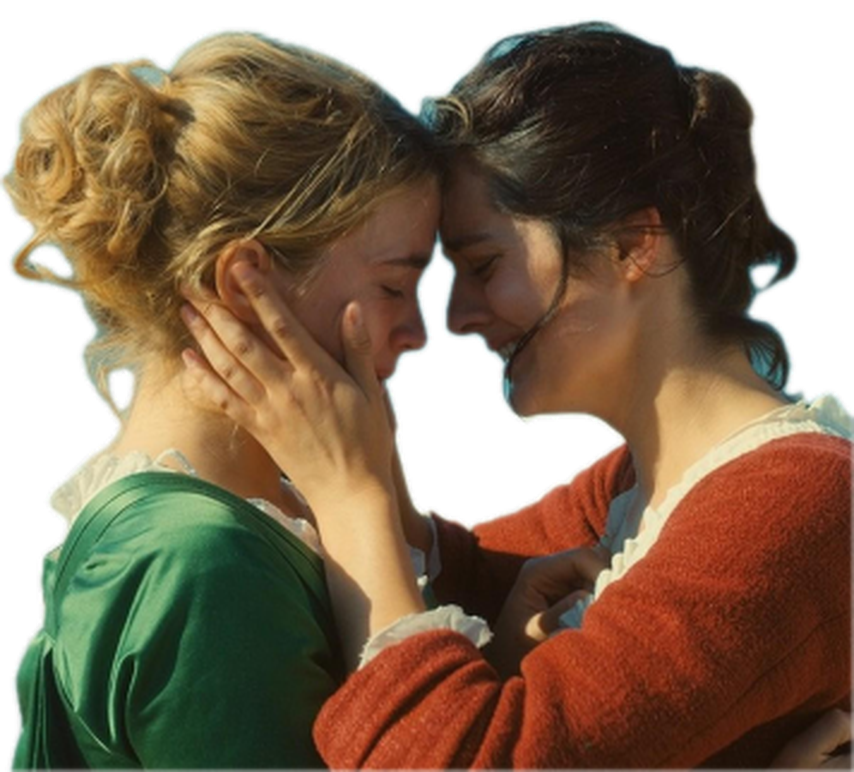
Portrait of a Lady on Fire expressed its feminism very differently. The film does not point out patriarchy directly and does not use many speeches to explain women’s oppression, like in Barbie. Instead, its feminist perspective is built into the relationship between Marianne, a female painter, and Héloïse, the woman she is asked to paint. Marianne has been commissioned to paint a portrait of Héloïse to be sent to a man she has never met, so he can decide whether to marry her. At first, Marianne must secretly observe Héloïse because Héloïse refuses to sit for a marriage portrait. Héloïse is told that Marianne has been hired as her walking companion; Marianne studies and memorizes Héloïse’s face and movements during their walks and paints her from memory at night. In this situation, looking is a form of power: Héloïse is being turned into an image for a male viewer (Portrait of a Lady on Fire).
After Héloïse discovers Marianne’s real purpose, however, their relationship begins to change. She agrees to sit for the portrait, but she also looks back. She criticizes Marianne’s first portrait and points out that while Marianne has been studying her expressions and movements, she has also been studying Marianne. Héloïse is still a “model”, but she is not a passive object, because the painter no longer controls the gaze; it is shared. Later, the second portrait becomes more collaborative because both women participate in the process of looking and representation (Portrait of a Lady on Fire).
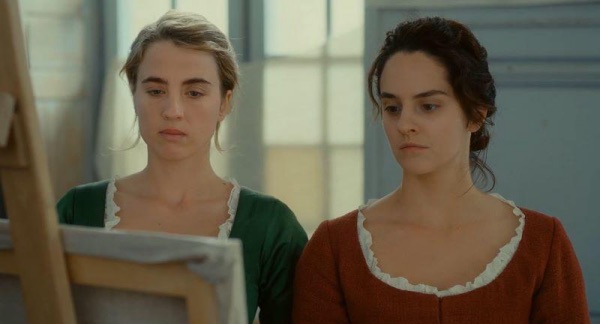
This mutual looking is one of the clearest ways the film creates a female gaze. Men are almost absent from the film, although male power still exists through Héloïse’s arranged marriage and the restrictions placed on Marianne as a woman artist. Sciamma creates a temporary space in which women can look at one another, desire one another, make art, and care for one another without men’s control. She has described the film as a love story built around equality and has rejected the traditional division between the artist and the “muse”; for her, the model and the artist are co-creators. In diametric opposition to the direct feminist language of Barbie, Portrait of a Lady on Fire expresses its politics through silence, eye contact, bodily distance, painting, and memory. Its tone is restrained and intimate rather than openly comic or angry (Portrait of a Lady on Fire; Stevens).
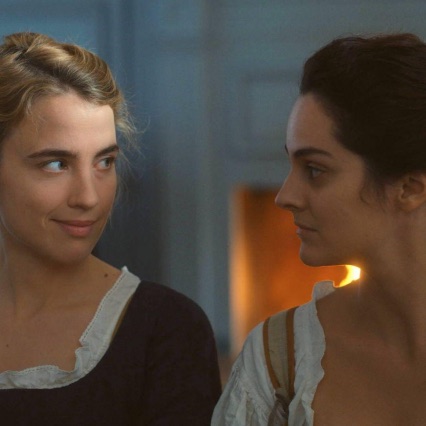
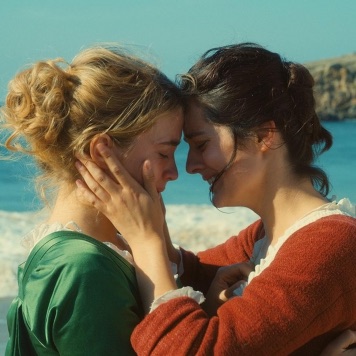
Moreover, even when the two women cannot remain together in the end due to realistic reasons, the film does not depict their relationship as a tragedy. Their love continues through memory, art, and the experience of having seen and been seen by one another. Critics have also emphasized that the film allows its feminist perspective to emerge through the way women see and represent one another. In this way, Portrait of a Lady on Fire reflects the French feminist concerns discussed in the previous section: female subjectivity, desire, the body, and the question of who has the right to look (Portrait of a Lady on Fire).
Night and Fog takes yet another approach. Inspired by a real domestic-violence case, the film follows Wong Xiaoling, a mainland Chinese woman who moves to Hong Kong after marrying Lee Sum, an older Hong Kong man. They live with their two young daughters in Tin Shui Wai, where their marriage unravels, as Xiaoling’s husband gradually becomes violent and controlling. Xiaoling tries more than once to leave and seek help, but she is trapped inside the structures that shape her choices. Many realistic factors make escape difficult: her immigrant status, motherhood, joblessness, lack of social support. Again and again, she has to return to her husband, even though he often beats her hard, hurting both her and their children. In the end, she and her children are killed by him. The film tells their story through flashbacks, slowly revealing how the relationship develops and how Xiaoling becomes trapped in it (Night and Fog).
The real case behind the film makes this even clearer: the woman had repeatedly sought help, had registered for employment training as she prepared for a more independent life, and had gone to a police station on her final day. She was trying to change her situation, but her choices were limited by the conditions around her (Night and Fog; “许鞍华|谈电影”).
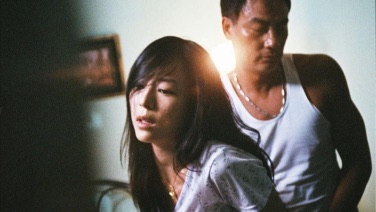
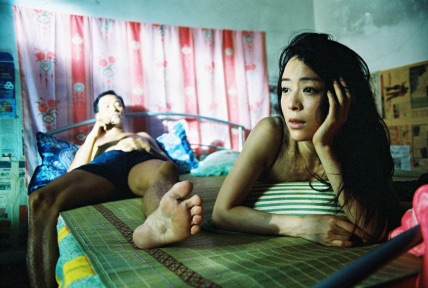
Xiaoling’s situation makes the feminist question in Night and Fog very different from that of the other two films. Ann Hui does not create an imagined feminist world like Barbie, or a temporary female space like the one in Portrait of a Lady on Fire. Her abusive marriage cannot be separated from migration, family responsibility, economic dependence, and the social systems around her. Her husband’s violence is central, but he is not the only reason she cannot leave. The police and welfare system give no effective response; as an immigrant, she has no relatives or friends in Hong Kong that care about her... In this sense, the film makes domestic violence beyond a private conflict between one cruel husband and one suffering wife; it’s a violence created by the whole society (Night and Fog).
The way Hui films Xiaoling makes this even clearer. The camera stays close to the ordinary conditions of Xiaoling’s life. We see her at home, taking care of her children, working, experiencing violence, and trying to find help. The tone is much darker than in the other two films. Xiaoling is angry, but she is also tired and afraid. Leaving is never shown as something she can easily decide to do. Barbie, an imaginary doll-lady, can eventually leave behind the role that has been designed for her; Marianne and Héloïse, at least for a short time, are able to create a space of their own, in part due to Héloïse’s relative economic privilege, in part because as an unmarried, rural woman in the 17th century, she is kept in isolation. Xiaoling never really has such a space. Even her private life is shaped by lack of money, by marriage, children, migration, and the institutions she depends on. This is very close to the tension I discussed earlier in Hong Kong feminism: women may appear to have more choices in public life, while the family can still remain a place where those choices become much more limited, and women are actually given so little room to act (Night and Fog).
Taken together, these three films show that feminist filmmaking does not have one fixed cinematic language. Barbie makes gender politics visible through comedy, speeches, fantasy, and popular culture; Portrait of a Lady on Fire works through gaze, intimacy, silence, and memory; Night and Fog places women’s choices inside the material realities of family, migration, poverty, and social institutions. Across different cultural contexts, filmmakers are finding very different ways to speak about female experience and challenge patriarchal structures. However, a film’s meaning changes when it reaches audiences outside the cultural context of its creation. In the case of feminist film, the same feminist language may be accepted, resisted, simplified, or translated into new cultural terms.
As a Chinese filmmaker who hopes to continue making films about women and gender, I am especially interested in what happens when feminist cinematic languages developed in different cultural contexts meet Chinese audiences. Understanding these responses matters to me not only as a researcher, but also as a creator who may one day face the same question in my own work: how can I speak about women’s experiences in ways that remain meaningful within the cultural context of the multiple audiences I hope to reach? Accordingly, the next section examines how these three films are interpreted when they enter Chinese cultural and media spaces.
IVReception in China
Barbie
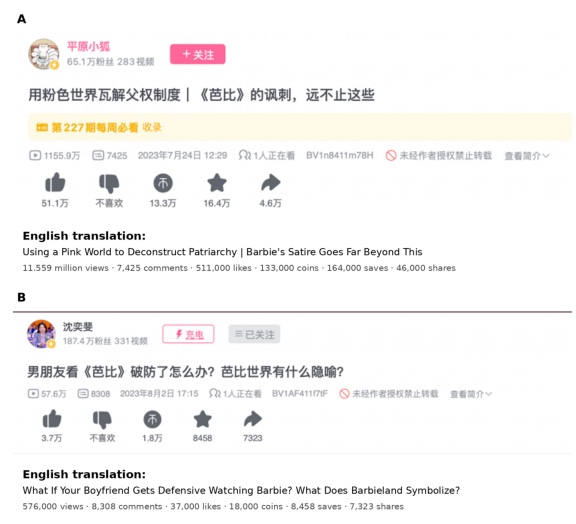
To investigate Barbie’s reception in China, I first examined comments under two highly engaged Bilibili videos about the film. Bilibili is one of China’s most influential online platforms, especially among younger users—in 2025, the average age of its active users was 26—and is active in discussions of film, culture, and social issues. The first, titled “Using a Pink World to Deconstruct Patriarchy: Barbie’s Satire Goes Far Beyond This,” had received more than 11.5 million views, 510,000 likes, and over 7,400 comments when I recorded the data. The second, “What If Your Boyfriend Is Offended by Barbie? What Is Hidden in Barbieland?”, had received more than 570,000 views and over 8,300 comments. Though comments on these two videos cannot represent all Chinese viewers, they still provide useful gender-focused case studies of some common ways Chinese audiences understood and discussed Barbie (Bilibili Inc.; “Using a Pink World”; “What If Your Boyfriend”).
Previous research shows that these Bilibili comments were not isolated examples. Jiao et al., who studied Chinese social-media responses to Barbie, found strong disagreements around feminism, with different gender groups and platforms responding to the film in different ways. Their study provides a broader background for my analysis (Jiao et al.).
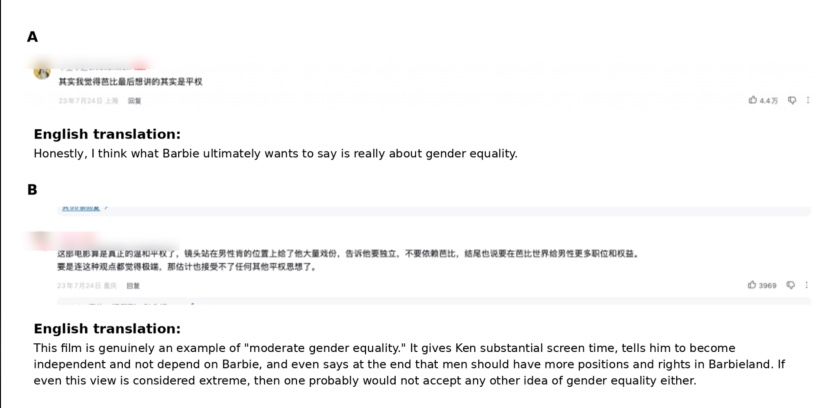
One common response was to describe Barbie less as a “feminist” film and more as a film about “gender equality” (平权). One of the most-liked comments under the first video, with more than 44,000 likes, states that “what Barbie really wants to talk about is equality” (平权). Another commenter describes the film as “truly moderate equality” (真正的温和平权), adding that if even this view is considered “extreme,” then other ideas about equality would probably not be accepted. In the Chinese online context, discussions of feminism are often connected with terms such as “gender equality” (平权), “extreme feminism” (极端女权), and “gender antagonism” (性别对立). These words are drawing boundaries around feminism: what level of feminism is “acceptable”? And when does it become “extreme”? Some Chinese viewers are more willing to accept feminist ideas framed as “gender equality” rather than “feminism,” since feminists are often perceived in Chinese culture as being “extreme” or creating gender conflict (“Using a Pink World”; “What If Your Boyfriend”).
A similar tendency of making the film’s feminist message less gender-specific appears in another comment. The commenter argues that if “women” in Gloria’s speech were replaced with “men,” much of the speech would still make sense, since both men and women are expected to become successful, improve themselves, and appear “perfect.” They use the Chinese internet expression “摆烂” (bailan)—giving up on the pressure to keep competing and improving—as a response to these expectations. In these comments, Gloria’s speech is not just about pressures placed on women; it becomes a criticism of the pressure everyone in society faces. This framing easily connects with the experiences of many Chinese young people, but it avoids the gender-specific meaning of Gloria’s speech. This de-gendered perspective weakens concerns about why women bear these pressures and how these pressures are related to the gender structure (“Using a Pink World”; “What If Your Boyfriend”).
Like the earlier comments about “gender equality,” this interpretation turns Barbie’s feminism into a broader and less confrontational social message. This is a kind of reception with strong Chinese context: the audience translates feminist criticism into a more general social criticism that is less suggestive of gender conflict. Otherwise, the discussion can easily raise concerns about “gender antagonism” (性别对立). Guan and Shang (2026), for example, find that “gender antagonism” has become a common term on Chinese social media and, on Weibo, even a category used in platform governance. When both men and women are put into the same category of “the oppressed”, however, the power differences between genders would no longer be the center of discussion. The center of the problem shifts from power inequality between genders to shared suffering under social pressure (Guan and Shang; “Using a Pink World”).
The comments also translate Barbie into Chinese, the popular-cultural language of the "independent woman” narrative. One highly-liked comment calls Barbie “my first 大女主,” 大女主 is Chinese term commonly used for a female protagonist whose story emphasizes her own agency and central position. Chinese audiences don’t directly translate the western theoretical expression of “female subjectivity” into Chinese, but rather put Barbie into a familiar local category to better understand it. This makes Barbie’s feminism more familiar to Chinese viewers, but also shifts attention away from structural gender inequality, reducing its broader social message to that of an individual woman becoming strong and independent. As a result, feminism becomes a story of individual self-improvement, while the social structures that produce gender inequality receive less attention (“Using a Pink World”).
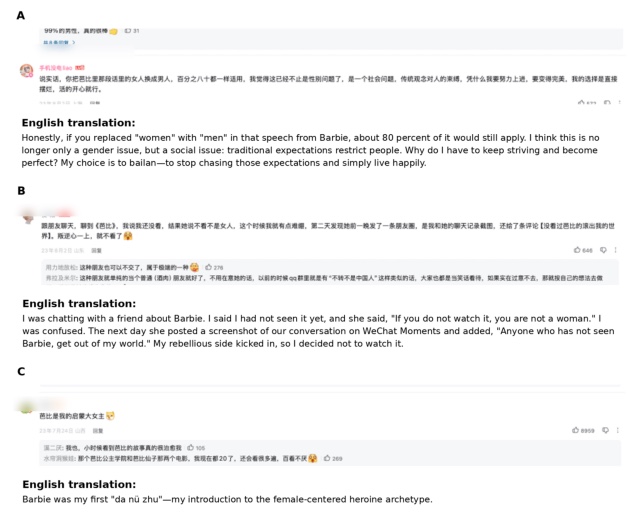
Moreover, the discussion of Barbie moved beyond the film itself and into viewers’ everyday relationships. The title of the second Bilibili video asks what happens when a “boyfriend” becomes offended while watching Barbie, suggesting that the film can reveal differences in how couples think about gender. This framing was not unique to that video. In July 2023, Sixth Tone reported that some Chinese social-media users used men’s reactions to Barbie as a way to evaluate dates or boyfriends, and many others shared stories of couples arguing over the film’s gender politics. In my Bilibili sample, one man commenter watched the film with his girlfriend, but his girlfriend found it boring and felt that it was somewhat unfair to men, while he enjoyed the film and thought it was “pretty good.” He makes fun of his girlfriend and himself, as being “the opposite of other couples.” A reply says that they both are great because she was able to empathize with men while he was able to empathize with women. These comments reveal Barbie’s function as a way for couples to discover and discuss differences in how they understand gender, and that these differences did not always follow the expected male-versus-female division. Additionally, another commenter describes first hearing about the film in a conversation with a friend who later posted their discussion on Barbie to WeChat Moments. These examples show that the film’s reception did not stay inside cinemas or film-review spaces. Its ideas move through conversations, friendships, social-media feeds, and everyday relationships, becoming part of how Chinese people discuss gender in everyday life (Yang; “What If Your Boyfriend”).
I also see many opposing voices among comments. Yet criticism and reinterpretation are part of the reception. One commenter writes, “Barbie still has many problems, but we need more films like Barbie.” The importance of “we need more Barbie” suggests that mainstream films openly centered on women’s experiences and gender inequality still feel relatively rare to some Chinese viewers. The film may be imperfect, and its feminism may seem too direct or even uncomfortable to some audiences, but this discomfort is part of the reasons that make such films valuable in China: by generating so much debate around “gender equality,” “extreme feminism,” “gender antagonism,” and the “大女主” (independent female protagonist) they bring feminist questions into a mainstream cultural space where these questions are still contested. Those of us who feel this way are not hoping that one film can settle these debates, but that more films like Barbie can make conversations about women and gender increasingly visible and difficult to dismiss (“Using a Pink World”; “What If Your Boyfriend”).
Such conversations develop beyond individual reactions. Yuan et al., based on interviews with 23 Chinese feminist fans of Barbie, found that participants built forms of collective identity around the film and adapted Barbie into a symbol of empowerment connected to Chinese social realities. In this sense, the value of Barbie in China may manifest not only in the values it spreads, but also in the conversations it allows to continue and the community that it creates for ongoing gender discussions (Yuan et al.).
Portrait of a Lady on Fire
In my following investigation of Portrait of a Lady on Fire’s reception in China, I use a different set of materials from those I used for Barbie. In place of using comment sections under popular videos online, I examine the film’s exhibition at the Beijing International Film Festival, long-form reviews on Douban and Bilibili, and discussions by Chinese film critics and scholars. This difference partly reflects how the two films entered Chinese culture: Barbie arrived as a mainstream commercial event and generated large public arguments about feminism, while Portrait of a Lady on Fire received less attention, mainly circulating through film-festival, cinephile, feminist, and queer film spaces. Obviously, these materials cannot represent all Chinese viewers, but they help us get a glance into how the film was understood within Chinese feminist and art-house film culture.
The film was introduced to Chinese audiences through a female-centered context. At the 2020 Beijing International Film Festival, Portrait of a Lady on Fire was selected for the newly created “Women’s Voices” (女性之声) section, which focused on women’s lives and inner experiences. It received five screenings. Chinese director Chen Zhengdao, recommending the film for the festival, described it as a rare film centered entirely on women’s love. He also praised the delicacy of its emotions and visual style. Therefore, the film was introduced to Chinese audiences not simply as a romance, but as a film centered on women and women’s experiences (Ni; Zhou).
One word appears particularly often in Chinese discussions of the film: equality (平等). Chinese feminist film scholar Dai Jinhua’s discussion of the film is titled around the idea of a passionate and equal gaze, and she argues that the film uses a same-sex love story to imagine the possibility of equality in intimate relationships. For Dai, this equality happens partly because the relationship is between two women: unlike heterosexual relationships that already exist within a gender hierarchy, Marianne and Héloïse do not begin with the same fixed structure of male power and female submission. A Bilibili video essay is titled “The Gravity of Equality” (平等的重力), while another video centers around the question “Can equal love exist?” A Douban reviewer writing about a Beijing International Film Festival screening also uses the phrase “mutual and equal gaze” (双向且平等的凝视) to describe Marianne and Héloïse’s relationship. These titles show how strongly the idea of equality shapes Chinese discussions of the film (Dai; “The Gravity of Equality”; “Can Equal Love Exist?”; 灵魂漫谈录).
It’s important to make it clear the definition of “equality” in these discussions. When commenting on this film, Chinese audiences not only use the term as a general statement that women should be equal to men. They are also describing a relationship in which neither woman remains fixed as the more powerful subject or the passive object. In this sense, “equality” refers not only to power between genders, but also more broadly to how power operates within an intimate relationship (Dai; 灵魂漫谈录).
However, this audience focus on intimate relationships does not mean that gender becomes unimportant. Within the terms of the film, gender is central to this equality, and to why it matters. Héloïse is initially being turned, by a male stranger, into a portrait for another male stranger who will decide whether to marry her. She is placed in the position of being looked at and judged by men. Marianne’s relationship with her gradually changes this structure: Héloïse looks back, criticizes the portrait, studies Marianne in return, and participates in how she is represented. Their equality does not come simply from the fact that they are two women. It comes from the film creating a temporary relationship outside the usual structures of heterosexual marriage and the male artist–female muse tradition, where the roles of subject and object can be renegotiated (Portrait of a Lady on Fire).
This question of the discussion of “equality” is not uniquely Chinese. What is more specific to the Chinese reception I examined is that critics prefer to use the language of “equality” (平等), “mutual gaze” (互相凝视), and “equal gaze” (平等凝视) to explain this relationship. “Gender equality”, which is more familiar and less contested to Chinese people, is used more often in contemporary Chinese gender discourse than “feminism”, which is often considered as a Westernized, elitist, or controversial concept. Yet here, “equality” does not make feminism sound more moderate, as it sometimes does in the reception of Barbie. Instead, it becomes a way to describe how power works inside the relationship between Marianne and Héloïse: Neither person remains permanently the subject, and neither is fixed as the object (Dai; Jiao et al.).
This can be seen clearly in one long Douban review, which argues that Sciamma changes the traditional power structure of “gazing” (凝视) into a more attentive action of “looking” (注视). Marianne observes Héloïse in order to paint her, but Héloïse also looks back, studies Marianne, and later points out Marianne’s own habits and gestures. The painter watches the model, but the model also watches the painter. In the reviewer’s interpretation, looking becomes something created between two subjects rather than a one-directional act in which one person controls the other (voidtakowlands).
“Female gaze” is thus translated into Chinese discussions in the following way: not simply that a woman replaces a man to become the person who looks, but that the person being looked at is allowed to look back and participate in how she is seen. Dai Jinhua argues that the traditional relationship between “artist” and “muse” is changed in this film because the gaze no longer belongs entirely to the artist. In this view, the female gaze is not a reversal of power, but a way of reciprocal looking (Dai).
Some Chinese critics further broaden the film’s idea of equality beyond its specific gender context. Marianne and Héloïse’s relationship becomes a way to ask whether any intimate relationship can avoid a fixed hierarchy between a more powerful subject and a more passive partner. This makes the film easier to connect with relationships in general, but it can also move attention away from the gender conditions that make this equality possible in the first place (Dai; “Can Equal Love Exist?”).
This is different from the de-gendering I found in the Chinese reception of Barbie. In Barbie, localizing feminism through “equality” can sometimes weaken its gender-specific criticism by turning women’s experiences into a more general story about pressure faced by everyone in society. In Portrait, broadening “equality” beyond gender instead turns a specifically female and queer relationship into a larger question about equality in human relationships. In both cases, gender-specific meanings become more universal, but they do so in different ways (Dai; Jiao et al.).
Another notable pattern is that many Chinese discussions do not enter the film through feminist theory. Instead, viewers often lead by talking about its beauty and emotions. Many Douban reviews mention its oil-painting-like images, restrained emotions, silence, memory, the Orpheus myth, and the final scene with Vivaldi. And many also focus on the plot, such as the sadness of the love story and the memory left after the two women separate (灵魂漫谈录; BaladeurS).
Since Portrait of a Lady on Fire is also received in China more as an art-house love story than a feminist or queer film, its impact is very different from Barbie’s. Barbie directly asks its audience to respond to gender issues and expresses direct criticism of patriarchy. In Portrait, on the contrary, feminism is expressed indirectly through scenes of daily life, through a mutual gaze. Attracted by the film’s visual style or emotions, some Chinese viewers focus much more on visual style and emotion than on the film’s gender politics (灵魂漫谈录; BaladeurS).
Moreover, the reception of the film changes with personal experience. One Douban writer notes that she disliked the film when first watching it in university, but when watching it again several years later after a breakup, she responded to it very differently. Another reviewer also says that rewatching the film let them recall those emotional details that they had missed before. Though not representative of all Chinese audiences, these reviews still suggest another difference from the reception of Barbie. Barbie brings an immediate reaction: viewers quickly debate its feminism, while Portrait creates a slower and more personal kind of reception, in which the meaning of the film changes with audiences’ own memories, relationships, and rewatching (都市丽踢; BaladeurS).
This also helps explain why discussions of Portrait have continued in Chinese online film culture years after its release. Bilibili video essays still return to themes such as equality, looking and being looked at, restraint, and memory. Rather than creating one large moment of public debate, the film continues to be revisited and reinterpreted within smaller cinephile and feminist film communities (“The Gravity of Equality”; “The Infinity of Restraint”; “Can Equal Love Exist?”).
One experience we can draw from this comparison of the two films’ reception is that the cultural differences that shape cross-cultural reception do not necessarily weaken or strengthen the feminist message of the film as originally understood in its own cultural context. In the reception of Barbie, translating feminism into “equality” makes its gender-specific criticism appear more general and less confrontational. Conversely, in Portrait, “equality” helps Chinese viewers describe a different structure of looking and loving. Meanwhile, approaching the film mostly through beauty and emotion can make its feminism easier to enter, but may also move attention away from its specific queer and political context. To conclude, Chinese audiences are not just accepting or rejecting the film’s feminist ideas. They are selecting different parts of the film and connecting them with their own ways of understanding relationships, art, gender, and memory.
Night and Fog
My investigation of the reception of Night and Fog (2009, Ann Hui) in China is slightly different from that of the previous two films. Unlike Barbie and Portrait of a Lady on Fire, Night and Fog is not a “Western feminist film entering China,” but rather a Chinese social story being reinterpreted across different Chinese cultural contexts. As a Chinese-language Hong Kong film, Night and Fog is based on a real domestic-violence case in Tin Shui Wai. Therefore, I looked at how this story was understood across different Chinese spaces, including mainland film reviews, Bilibili video essays, discussions of Hong Kong society, and interviews with Ann Hui. Compared with the previous two films, its reception is less centered on feminism. Beyond gender, viewers also discuss poverty, migration, family, social welfare, or the failures of public institutions. This complexity makes the feminist meaning of Night and Fog only one part of a broader discussion about social inequality and marginalization (Night and Fog; “许鞍华|谈电影”).
Interestingly, one of the most visible points of entry into mainland online platforms is through discussions of domestic violence (家暴). Bilibili videos use titles such as “more terrifying than a horror film” and “explaining domestic violence completely.” One of these videos introduces the film through the “2004 family tragedy” adding that domestic violence either happens “zero times or countless times.” Many videos place the film under categories such as crime and domestic violence (“More Terrifying than a Horror Film”).
These labels are eye-catching, but they narrow the way viewers approach the film. When Night and Fog is mainly described as a horrifying story of domestic violence or a real-life family tragedy, attention is easily drawn to how violent Li Sen is and how shocking the case is. Viewers may also focus too much on Xiaoling’s visible fear, suffering, or even appearance; some may even “watch” her pain with a kind of prurient curiosity. Yet the film spends much more time asking why Xiaoling remains trapped even after she tries to leave and seek help. Poverty, migration, economic dependence, social isolation, and failures of social support are all part of that tragedy. We cannot simplify the film or blur its true story. This type of propaganda that shifts the focus shows how platforms can influence reception. A title such as “more terrifying than a horror film” can attract viewers quickly. In this sense, reception is shaped not only by what viewers say after watching a film, but also by how the film is packaged before they watch it (“More Terrifying than a Horror Film”; Night and Fog).
More detailed Chinese discussions often expand the story beyond domestic violence. Xiaoling has many identities. Besides being a woman abused by her husband, she is also a mainland woman who moves to Hong Kong through marriage, lives in a low-income community, has limited local connections. She depends on a husband who has more social and economic power. Mainland Chinese film reviews and media discussions of Tin Shui Wai understand the film in terms of the difficulties faced by new mainland immigrants and low-income families in Hong Kong. Contemporary reporting noted that domestic violence was a serious issue among some new-immigrant families and directly mentioned Night and Fog when discussing this problem. Xiaoling’s vulnerability cannot just be explained through gender. It is intersectional, connected with class, migration, and regional inequality altogether (炫风 and 曾明瑞).
This leads to one of the most important questions in the film’s reception. Many people ask, “Why didn’t she leave?” But Xiaoling does try to leave. Both the film and the real case show that Xiaoling sought help many times and moved toward a more independent life, yet these attempts did not allow her to escape the violence. Female “agency” here is not merely a choice, but heavily depends on whether the conditions around her make that choice possible (Night and Fog; “许鞍华|谈电影”).
The perception of female “agency” in Night and Fog poses an interesting contrast with the reception of Barbie. As mentioned above, some Chinese viewers translate Barbie’s feminism into “大女主” a woman becoming independent, strong, and in control of her own life. While Night and Fog shows the limits of that idea, some viewers nonetheless struggle to perceive those limits.
Another difficult question centers on Li Sen, the husband. The film does not present him as a completely unexplained “monster.” His unemployment, economic frustration, aging, insecurity, and need for control are all shown as part of the background of his violence. These details suggest that domestic violence does not appear from nowhere; it can also be connected with economic pressure, masculinity, and a loss of social status (Night and Fog).
However, explaining these conditions creates a risk. If viewers spend too much time asking why Li Sen became violent, they may begin to sympathize with his difficulties and shift their attention away from his own responsibility and Xiaoling’s suffering. Yet if he is treated only as an evil individual, the larger social conditions behind the violence disappear again. This creates a difficult balance: understanding the social causes of violence is necessary, but explanation should not become an excuse for the person who commits it, nor should it lead, as it does in Chinese reception of Barbie, to false equivalences (Night and Fog).
Overall, the Chinese reception of Night and Fog shows that gender violence cannot be understood through gender alone. Depending on what viewers focus on, the same film can become a shocking domestic-violence case, a story about a mainland migrant woman, a criticism of social welfare, or a discussion of poverty and unequal marriage. Each interpretation makes one part of the film more visible, but may also push other parts into the background.
VConclusion
The reception of these three films in China shows that feminist ideas change when they travel across cultures. In Barbie, many Chinese viewers translate feminism into familiar terms such as “gender equality” (平权) and the “大女主,” sometimes making its criticism of gender inequality more general and less confrontational. In Portrait of a Lady on Fire, the same language of “equality” works differently: it helps viewers describe mutual gaze, equal love, and a relationship in which neither woman is reduced to an object. The film is also often approached through beauty, emotion, and memory, which make its feminist and queer meanings less visible. For Night and Fog, while online discussions often introduce the film through domestic violence and a shocking real case, more detailed readings connect the woman’s situation to migration, poverty, family, and failures of social support. Across the three films, Chinese audiences emphasize different aspects of feminism depending on the cinematic form of the film and the cultural language available to them. Film is not only a way to transmit feminist ideas, but also a space where those ideas are changed through contact with different audiences.
Seen together, these films suggest that there is no single global feminist conversation moving in one direction. Instead, that conversation grows through difference. American, French, Hong Kong, and Chinese cultural contexts bring different histories, priorities, and vocabularies to questions about women’s freedom, desire, representation, and power. When feminist films move between these contexts, some meanings are softened, others become more visible, and new questions emerge. These changes allow the conversation to morph, deepen, and continue, as viewers and filmmakers use different cultural experiences to reconsider what equality, agency, and female subjectivity can mean.
Bibliography
- Alexander, Kerri Lee. “Feminism: The First Wave.” National Women’s History Museum, 5 Apr. 2021, https://www.womenshistory.org/exhibits/feminism-first-wave-0. Accessed 26 Oct. 2026.
- All About Love. Directed by Ann Hui, 2010.
- BaladeurS. “假如重逢 [If They Met Again].” Douban, 20 Apr. 2020, https://movie.douban.com/review/12524131/. Accessed 26 Oct. 2026.
- The Balconettes. Directed by Noémie Merlant, 2024.
- Barbie. Directed by Greta Gerwig, Warner Bros., 2023.
- Beauvoir, Simone de. The Second Sex. Translated by Constance Borde and Sheila Malovany-Chevallier, Vintage, 2011.
- Bilibili Inc. Q2 2025 Bilibili Inc. Investor Presentation. 2025, https://ir.bilibili.com/media/ayhjclou/q2-2025-bilibili-inc-investor-presentation.pdf. Accessed 26 Oct. 2026.
- The Bride!. Directed by Maggie Gyllenhaal, Warner Bros., 2026.
- Butler, Judith. Gender Trouble: Feminism and the Subversion of Identity. Routledge, 1990.
- “Can Equal Love Exist? [银河影评:燃烧女子的肖像-上:平等的爱有可能存在吗].” Bilibili, 17 Dec. 2022, https://www.bilibili.com/video/BV12V4y1A718/. Accessed 26 Oct. 2026.
- China Film Administration. “电影产业促进法 [Film Industry Promotion Law].” China Film Administration, 7 Nov. 2016, https://www.chinafilm.gov.cn/xxgk/zcfg/flfg/201611/t20161107_1460.html. Accessed 26 Oct. 2026.
- Cixous, Hélène. “The Laugh of the Medusa.” Translated by Keith Cohen and Paula Cohen, Signs, vol. 1, no. 4, 1976, pp. 875–93. https://doi.org/10.1086/493306.
- Cléo from 5 to 7. Directed by Agnès Varda, 1962.
- Crenshaw, Kimberlé. “Demarginalizing the Intersection of Race and Sex: A Black Feminist Critique of Antidiscrimination Doctrine, Feminist Theory and Antiracist Politics.” University of Chicago Legal Forum, 1989, pp. 139–67.
- Dai, Jinhua. “《燃烧女子的肖像》:炙热的凝视,平等的凝视 [Portrait of a Lady on Fire: A Passionate Gaze, an Equal Gaze].” The Paper, 15 Feb. 2022, https://www.thepaper.cn/newsDetail_forward_16694166. Accessed 26 Oct. 2026.
- Dargis, Manohla. “‘The Bride!’ Review: Frankie, My Dear.” The New York Times, 5 Mar. 2026, https://www.nytimes.com/2026/03/05/movies/the-bride-review.html. Accessed 26 Oct. 2026.
- Gonzalez, Umberto. “Female Directors See ‘Complete Reversal’ of Progress as 2025 Marks 5% Drop in Film Work, Study Finds.” TheWrap, 31 Dec. 2025, https://www.thewrap.com/creative-content/movies/female-directors-work-drops-5-points-2025/. Accessed 26 Oct. 2026.
- “The Gravity of Equality [《燃烧女子的肖像》评析—平等的重力].” Bilibili, uploaded by 锈山, 21 Mar. 2020, https://www.bilibili.com/video/BV1KE411A7oc/. Accessed 26 Oct. 2026.
- Guan, Zexu, and Zheyu Shang. “Constructing Gender Antagonism: Moralised Platform Governance in China.” Media and Communication, vol. 14, 2026, article 12064. https://doi.org/10.17645/mac.12064.
- Half the Picture. Directed by Amy Adrion, 2018.
- hooks, bell. Feminist Theory: From Margin to Center. South End Press, 1984.
- “The Infinity of Restraint [《燃烧女子的肖像》评析—克制的无穷].” Bilibili, uploaded by 锈山, 17 Apr. 2020, https://www.bilibili.com/video/BV1Ta4y147KR/. Accessed 26 Oct. 2026.
- Irigaray, Luce. This Sex Which Is Not One. Translated by Catherine Porter with Carolyn Burke, Cornell UP, 1985.
- Jiao, Lin, et al. “Polarized Views over Feminism: Gendered Reception of Barbie among Chinese Audiences on Social Media.” Feminist Media Studies, vol. 26, no. 5, 2026, pp. 1581–98. https://doi.org/10.1080/14680777.2025.2478390.
- Kristeva, Julia. Revolution in Poetic Language. Translated by Margaret Waller, Columbia UP, 1984.
- Lee, Eliza Wing-Yee, editor. Gender and Change in Hong Kong: Globalization, Postcolonialism, and Chinese Patriarchy. UBC Press, 2004.
- Library of Congress. “Ruth Handler, Entrepreneur, Introduces the Barbie Doll.” This Month in Business History, https://guides.loc.gov/this-month-in-business-history/march/ruth-handler-introduces-barbie. Accessed 26 Oct. 2026.
- Library of Congress. “20th Century: The Waves of French Feminism.” French Women & Feminists in History: A Resource Guide, https://guides.loc.gov/feminism-french-women-history/20th-century. Accessed 26 Oct. 2026.
- Lim, Adelyn. Transnational Feminism and Women’s Movements in Post-1997 Hong Kong: Solidarity Beyond the State. Hong Kong UP, 2015. https://doi.org/10.5790/hongkong/9789888139378.001.0001.
- Little Women. Directed by Greta Gerwig, Sony Pictures Releasing, 2019.
- Lorde, Audre. Sister Outsider: Essays and Speeches. Crossing Press, 1984.
- “More Terrifying than a Horror Film: Explaining Domestic Violence [〖越哥〗让人头皮发麻的华语电影,比恐怖片还恐怖,说透了家庭暴力这件事!《天水围的夜与雾》].” Bilibili, uploaded by 越哥说电影, 12 June 2020, https://www.bilibili.com/video/BV1UK4y1x7AP/. Accessed 26 Oct. 2026.
- Mulvey, Laura. “Visual Pleasure and Narrative Cinema.” Screen, vol. 16, no. 3, 1975, pp. 6–18. https://doi.org/10.1093/screen/16.3.6.
- Munro, Ealasaid. “Feminism: A Fourth Wave?” Political Insight, vol. 4, no. 2, 2013, pp. 22–25. https://doi.org/10.1111/2041-9066.12021.
- National Archives. “19th Amendment to the U.S. Constitution: Women’s Right to Vote (1920).” National Archives, https://www.archives.gov/milestone-documents/19th-amendment. Accessed 26 Oct. 2026.
- News from Home. Directed by Chantal Akerman, 1976.
- Ni, Wei. “北影节展映将开启,侯麦影展、《82年生的金智英》等登陆影院 [Beijing International Film Festival Screenings to Begin].” The Beijing News, 13 Aug. 2020, https://m.bjnews.com.cn/detail/159728777815963.html. Accessed 26 Oct. 2026.
- Night and Fog. Directed by Ann Hui, 2009.
- Petite Maman. Directed by Céline Sciamma, 2021.
- Portrait of a Lady on Fire. Directed by Céline Sciamma, 2019.
- Promising Young Woman. Directed by Emerald Fennell, Focus Features, 2020.
- Shaw, Gareth, and Xiaoling Zhang. “Cyberspace and Gay Rights in a Digital China: Queer Documentary Filmmaking under State Censorship.” China Information, vol. 32, no. 2, 2018, pp. 270–92. https://doi.org/10.1177/0920203X17734134.
- Smith, Stacy L., et al. Inclusion in the Director’s Chair? Gender, Race, & Age of Film Directors Across 1,000 Films from 2007 to 2016. USC Annenberg Media, Diversity, & Social Change Initiative, 2017, https://annenberg.usc.edu/sites/default/files/2017/04/06/MDSCI_Inclusion%20_in_the_Directors_Chair.pdf. Accessed 26 Oct. 2026.
- Stevens, Isabel. “No Man’s Land: Céline Sciamma on Portrait of a Lady on Fire.” Sight and Sound, British Film Institute, 8 Dec. 2022, https://www.bfi.org.uk/sight-and-sound/features/no-mans-land-celine-sciamma-portrait-lady-fire. Accessed 26 Oct. 2026.
- Sun, Haocan, and Jinghong Xu. “Gender Stereotypes and Composition in the Chinese Film Industry: A Study of the Top 15 Grossing Films.” Journal of Broadcasting & Electronic Media, vol. 68, no. 1, 2024, pp. 125–44. https://doi.org/10.1080/08838151.2023.2298276.
- University of Amsterdam. “Chinese, Female Filmmakers through a Feminist Lens.” 6 Jan. 2022, https://www.uva.nl/en/shared-content/faculteiten/en/faculteit-der-geesteswetenschappen/news/2022/01/chinese-female-filmmakers-through-a-feminist-lens.html. Accessed 26 Oct. 2026.
- “Using a Pink World to Deconstruct Patriarchy: Barbie’s Satire Goes Far Beyond This [用粉色世界瓦解父权制度|《芭比》的讽刺,远不止这些].” Bilibili, uploaded by 平原小狐, 24 July 2023, https://www.bilibili.com/video/BV1n8411m78H/. Accessed 3 Oct. 2026.
- voidtakowlands. “浅析《燃烧女子的肖像》中的目光 [A Brief Analysis of the Gaze in Portrait of a Lady on Fire].” Douban, 2 July 2022, https://movie.douban.com/review/14489951/. Accessed 26 Oct. 2026.
- Water Lilies. Directed by Céline Sciamma, 2007.
- The Way We Are. Directed by Ann Hui, 2008.
- “What If Your Boyfriend Gets Defensive Watching Barbie? What Does Barbieland Symbolize? [男朋友看《芭比》破防了怎么办?芭比世界有什么隐喻?].” Bilibili, uploaded by 沈奕斐, 2 Aug. 2023, https://www.bilibili.com/video/BV1AF4117tfF/. Accessed 3 Oct. 2026.
- Yang, Caini. “Despite Slow China Start, ‘Barbie’ Sets a Benchmark — For Dating.” Sixth Tone, 24 July 2023, https://www.sixthtone.com/news/1013374. Accessed 26 Oct. 2026.
- Yuan, Xinyao, et al. “Feminist Fan Engagement and Collective Agency: A Case Study of Barbie in China.” International Journal of Cultural Studies, vol. 29, no. 2, 2026, pp. 291–310. https://doi.org/10.1177/13678779251358881.
- Zhou, Huixiaowan. “北影节300部佳片,李少红、李晨、黄晓明等推荐这20部 [Twenty Recommended Films at the Beijing International Film Festival].” The Beijing News, 20 Aug. 2020, https://m.bjnews.com.cn/detail/159790578015295.html. Accessed 26 Oct. 2026.
- 灵魂漫谈录. “北影节女性之声单元:《燃烧女子的肖像》 [BJIFF Women’s Voices: Portrait of a Lady on Fire].” Douban, 2 Sept. 2020, https://movie.douban.com/review/12843965/. Accessed 26 Oct. 2026.
- 炫风, and 曾明瑞. “‘悲情市镇’天水围 [Tin Shui Wai, a ‘Town of Sorrow’].” 南都周刊 [Southern Metropolis Weekly], 15 July 2011, https://news.sina.com.cn/c/sd/2011-07-15/152122820895_2.shtml. Accessed 26 Oct. 2026.
- “许鞍华|谈电影,谈上海,谈《第一炉香》 [Ann Hui on Film, Shanghai, and Love after Love].” The Paper, 22 Oct. 2021, https://www.thepaper.cn/newsDetail_forward_15009422. Accessed 26 Oct. 2026.
- 都市丽踢. “五年后二刷,才看懂 [I Understood It Only after Rewatching Five Years Later].” Douban, 5 Sept. 2025, https://movie.douban.com/review/17041570/. Accessed 26 Oct. 2026.
End of essay · NOUS Review