During the Chenghua reign (1465-87) of the Ming dynasty, the gentry of Wuxi carried out a sequence of cultural undertakings around the local landmark of Mount Hui, among them the recovery of the bamboo tea stove, the solicitation of the poems gathered as the New Poems on the Bamboo Stove (Zhulu xinyong), and the founding of the Bishan Poetry Society. These undertakings have usually been treated in isolation, the stove as an elegant plaything of tea connoisseurship and the society as a pastime of commoner elders. In fact the two shared, to a striking degree, the same participants, the same channels of association, and the same symbolic resources.
This article examines how the Wuxi gentry, through the rewriting of narrative, bound the stove as an object to the image of the local forebear Wang Fu as a man of “lofty integrity”, and how the poem scrolls circulated between Wuxi and Beijing involving some most renowned high-ranking officials at that time. In the Painting of the Bishan Poetry Society, the ten commoner members, joined by ties of father and son, brotherhood, and marriage, offered the local elites a social platform on which a collective identity could be fashioned. The stove, the scrolls, and the painting thus came to form a set of mutually supporting cultural forms. These activities made Mount Hui a space in which officials and local gentry without civil-service degrees could exchange reputation, declare their aspirations, and preserve a common memory. The society’s adoption of the ancient precedent of the Society of the Nine Elders hints at the discontent of the Wuxi-born officials with the political decay in the later Chenghua years. Through the verse exchanges on the bamboo stove, Sheng Yong and the younger generation of Hanlin officials effected an exchange and a transmission of personal ethics and political ideals.
壹Introduction
During the Chenghua reign, two cultural undertakings arose within the local gentry circles of Wuxi 無錫 that would be remembered for centuries. During his home-return of mourning in 1477, Qin Kui 秦夔 (1433-1495), the prefect of Wuchang, helped Huishan Temple recover a bamboo tea stove that had drifted into private hands. This recovery of the bamboo tea stove set off a chain of poetic exchanges. Qin Kui first invited local scholars of Wuxi and then his official friends in Beijing to match his verses, producing two scrolls of poems. Later in 1483, the Wuxi official Sheng Yong 盛顒 (1418-1492), together with Wu Kuan 吳寬 (1435-1504) and a company of Hanlin officials, again exchanged verses on the bamboo tea stove, forming a third scroll. Together the three scrolls are known as the New Poems on the Bamboo Stove 竹爐新詠. The second undertaking came in 1482. At the initiative of Qin Kui’s father Qin Xu 秦旭, ten elderly commoners of Wuxi formed the Bishan Poetry Society 碧山吟社, built a hall and a pavilion beside the Second Spring of Mount Hui, held elegant gatherings and matched poems, and invited Shen Zhou 沈周 (1423-1509) to paint the Bishan Poetry Society (Figure 4).
What prompted these two local cultural events, and what were they meant to accomplish? Were the Wuxi gentry simply adding cultural capital to themselves and to their locality, or did the events carry deeper implications and symbolic weight? In the study of Elegant Gathering in the Apricot Garden (Figure 1), Yin Ji’nan found that the elegant gatherings of Ming officials, outwardly pastimes of leisure hours and nominally occasions of literary fellowship, in fact harbored an undercurrent of shared political expression.1 His finding indicates us that the gathering pictures and verse exchanges of the mid-Ming cannot be understood on the level of refined amusement alone. Did the cultural activities of these Wuxi gentry, conducted locally and in coordination with officials in the capital, hold a comparable depth of such intent?

Studies of Ming literati societies and elegant gatherings, for their part, have mostly taken the official circles of the capital or of Suzhou as their subject, and have rarely examined in depth how local gentry used a single object and a single celebrated site to organize cultural activity across regions. This article takes as its center the three scrolls of the New Poems on the Bamboo Stove and the founding of the Bishan Poetry Society. It first reconstructs the making, the loss, and the recovery of the bamboo tea stove, bringing to light the process by which its narrative was reconstructed. It then analyzes how Wang Fu’s image of “lofty integrity” took shape in scholarly circles and was deliberately put to use. Drawing next on the official careers of Qin Kui and Sheng Yong and on the politics of the Chenghua court, it considers in turn what each man intended in promoting the verse exchanges. Finally it returns to the Bishan Poetry Society, to explain how a society of commoners could draw in the gentry of Jiangnan, and how its membership overlapped inwardly with the network of participants in the New Poems on the Bamboo Stove. On this basis the article goes on to examine the symbolic meaning, within the political context of the day, of the Society of the Nine Elders that the bamboo stove poems and the Bishan Poetry Society took as their model.
貳The Narrative of the Bamboo Stove and the Persona of Wang Fu
The value of the bamboo tea stove was never fixed at the moment of its making. The discrepancies among the surviving accounts themselves reveal how, in the retelling of later generations, it gradually became a relic of Wang Fu 王紱 (1362-1416) and a piece of Mount Hui lore.
Wang Da’s Record of the Bamboo Stove was written in 1395. According to the essay, an unknown bamboo craftsman made the stove for Monk Xinghai 性海 during he was serving as the abbot of Huishan Temple. Wang Da described the form of the stove in detail, calling it “round above and square below, patterned on the form of heaven and earth”, can serve “lofty men and untrammeled scholars”. It demonstrates that “no distinction need be made between the noble and the mean”. The essay’s center of gravity lies with Xinghai, the bamboo craftsman, and the lesson of cultivation embodied in the object; it says nothing of Wang Fu taking part in its making. The related Preface to Pure Poems on the Bamboo Stove declares that “a thing cannot make itself precious; it is made precious through a person. A name cannot spread of itself; it is spread through intent”. What it esteemed was still the way of Xinghai, and it drew comparisons with the Lotus Society of Mount Lu and with Zhidun’s fondness for cranes.2 These two early texts had already established for the bamboo stove a mode of explanation in which things are “made precious through a person”, yet they did not identify that person as Wang Fu.
“A thing cannot make itself precious; it is made precious through a person.”
In 1488, Qin Kui rearranged the stove’s pedigree after he helped the temple find the stove. In his Record of the Recovery of the Bamboo Tea Stove, he first cited the poem of “the former worthy of our district, Drafter Wang”, and then Wang Da’s preface, saying that the stove’s fame had grown on these accounts. As for how the stove had left the monastery, he said only that after Xinghai’s death the stove too was cast adrift among men. A record written by Lu Jian in the same period states that the stove was made in the early Hongwu years, that it later fell to a great family within the city, and soon changed owners twice, and it likewise passes over the households in question.3 These accounts write a story of loss and recovery as the return of a famous relic, without acknowledging that the original stove had never been an owner-less castoff.
In 1518, Shao Bao’s 邵寶 (1460-1527) Account of the Bamboo Tea Stove supplied another line of transmission. As he had heard it, when Xinghai became abbot of Huqiu 虎丘 in the early Yongle years, he left the stove with Pan Kecheng 潘克誠 as a parting gift. The stove remained with the Pan family for more than sixty years. During the Chenghua period, a descendant of the Pans gave it to Yang Mengxian 楊孟賢, and only three years after Yang’s death did Qin Kui retrieve it from Yang’s elder brother Yang Mengjing 楊孟敬. Shao Bao took care to note that the news came from the husband of his maternal aunt, giving this piece of retrospection the character of a family report circulating within a marriage network.4 Seen in this light, the stove’s supposed drifting among men was in fact a passage from the monastery into the households of a local physician and a wealthy family, from which Qin Kui returned it to the Huishan temple. Qin Kui’s silence about the transfer between the Pan and Yang families need not have been deliberate concealment. Even so, the omission rewrote a complicated history of private possession into a clear history of a local treasure restored.
Shao Bao’s account also moved the date of the stove’s making to the fourth year of Jianwen (1402) and added episodes in which Wang Fu convalesced at the Listening to the Pines Hermitage. Wang Fu painted Mount Lu for Xinghai, and received a visit from Pan Kecheng, who came to see the painting. On this telling, the stove was made by a Huzhou bamboo craftsman at the bidding of Xinghai and Pan Kecheng, with Wang Fu inscribing a poem on the spot. Compared with Wang Da’s record, the date, the persons, and the order of precedence had all changed. The two versions cannot be forced into agreement. Wang Da’s earlier record proves that a bamboo stove existed by 1395. Shao Bao’s version reflects how later local scholars understood the stove’s relation to Wang Fu, to the Pan family, and to the hermitage.
This narrative shift had already appeared in the poetry exchanges in Beijing in 1483. Sheng Yong wrote that Wang Fu and Xinghai made the bamboo stove for boiling tea, and Wu Kuan, recording Sheng Yong’s words, stated that the stove came from Drafter Wang Fu himself.5 From an inscriber among the early poem scrolls, Wang Fu gradually became the stove’s maker and even its owner. The later accounts were no simple errors of transmission. What concerned Qin Kui, Sheng Yong, and Shao Bao was no longer who had designed the stove, so much as what sort of person could confer lasting fame upon an object. The formula “made precious through a person” that Wang Da had proposed found, between the Chenghua and Zhengde years, its most fitting candidate among local forebears.
Wang Fu’s Image and the Character Ascribed to the Stove
That Wang Fu displaced Xinghai at the center of the stove’s story has much to do with the formation of his posthumous image. When Wang Fu died in 1416, Wang Hong’s Brief Biography of Wang Mengduan described him as “lofty and untrammeled in spirit from his youth”, possessed of “the air of a true poet in his detachment”, and dwelt on his refusal to paint readily even for the powerful and wealthy. Wang Hong summed him up in the line “his resolve could hardly be moved by influence or gain”, a judgment still grounded in an eyewitness’s assessment of Wang Fu’s temperament and his principles of association. Zhang Bingru’s Account of Conduct of the Late Secretariat Drafter Wang Mengduan went further, saying that he “loved forthright words” and “argued to the utmost with a stern countenance, undaunted by the powerful”, and recording that whenever he spoke of climbing Mount Hui and boiling tea in the monks’ quarters, “his spirit would suddenly kindle”, while he remained indifferent to fame and profit.6 An upright and unbending character and the life setting of brewing spring water on Mount Hui had entered his biography together, at the latest by the time of his death.
The Wang Fu of the early records was nonetheless no recluse wholly removed from social obligation. Hu Guang’s 胡廣 (1370-1418) Funerary Inscription for Wang Mengduan says that he painted only when the mood arose, so that a man might seek a work for years without success, yet once inspiration came he could wield the brush in a continuous surge. The poems and prose of Hu Guang, Yang Rong 楊榮 (1372-1440), Jin Youzi 金幼孜 (1368-1432), and others further show that during his service in the capital as a Secretariat Drafter, Wang Fu did paint for Hanlin grandees of rather high rank.7 This does nothing to diminish his unbending integrity. It tells us that his refusals were aimed at requests that ran against his will; official intercourse as such he did not shun. That Wang Fu’s image grew ever more distinct owes precisely to the way biographies and anecdotes drew out of a complicated web of associations a single main thread, his refusal to be swayed by influence.
The story of “hearing a flute by moonlight” recorded in Ye Sheng’s 葉盛 (1420-1474) Diary of the East Waters (Shuidong riji 水東日記) was the key to the fixing of this image. Hearing the sound of a flute from a neighboring house at night, Wang Fu painted bamboo and rocks in the transport of the moment and gave the painting to the flutist. Learning that the man was a merchant, he did not ask it back, yet when the man came with lavish gifts to request a companion piece, Wang Fu rebuked him angrily, saying, “How could a vulgar fellow be worthy of my brush”, retrieved the earlier painting, and tore it up. Ye Sheng called him “a scholar of lofty integrity who rose utterly above the vulgar”.8 By placing the giving and the refusal of paintings in opposite circumstances, the story insists on the conditions under which painting and calligraphy may change hands, namely kindred spirit and shared intent. Ye Sheng died in 1474. It shows that the story had entered scholarly memory before Qin Kui recovered the stove. In choosing Wang Fu, Qin Kui, Sheng Yong and his circle were availing themselves of a persona already recognizable in their day.
“How could a vulgar fellow be worthy of my brush.”
The difference between Wang Fu and Ni Zan 倪瓚 (1301-1374) lies here as well. Both were former worthies of Wuxi, both famed as painters, and later generations characterized each with the word jie 介, unyielding. Ni Zan’s juanjie 狷介, his aloof fastidiousness, is bound up with flight from the disorders of the late Yuan and with a determination to keep himself unsullied. Wang Fu, by contrast, lived through exile, pardon, reclusion, renewed summons, and attendance on the emperor’s northern campaigns, and finally died in official quarters. His fame never rested on a lifelong refusal of office. What earned him his reputation was the steely uprightness, the refusal to drift with the vulgar, that he kept amid passages in and out of office and reclusion.9 For serving or retired officials such as Qin Kui and Sheng Yong, this made Wang Fu easier to take as a model than any pure recluse of the mountains and forests. He had the aspiration toward the forests and springs of Mount Hui, and also the experience of standing in the ranks of the court. He enjoyed the favor of recognition, yet never used his art to ingratiate himself with the powerful. The purity of the bamboo stove, its endurance of fire, and its use in boiling spring water accorded exactly with this ideal of remaining steadfast while holding office.
Qin Kui’s part was to resettle Wang Fu’s poetic fame at the Listening to the Pines Hermitage. What moved him to seek the stove was Wang Fu’s couplet, “Its vapor steams with the third month’s spring rains of Yangxian; its voice carries the autumn on both banks of the Xiang”. Having found the stove, he further entrusted the scrolls of both the local and the capital exchanges to the monks for safekeeping.10 What he restored was thus more than the original object. He restored the bonds among object, poem, person, and place. The stove left the Pan and Yang households and returned to the hermitage. Wang Fu’s poem left the old scroll and entered a new round of exchanges. Mount Hui acquired, on the strength of a “former worthy of the district”, a piece of lore that could be written onward.
叁The Circulation of the Poem Scrolls, Sheng Yong’s “Bitter Integrity”, and the Network of Two Places
That the recovery of the stove became more than a piece of local antiquarian lore turned on the circulation of the poem scrolls. Between the winter of 1477 and the spring of 1478, two rounds of exchanges took shape around the old stove. The first unfolded in Wuxi, with the participation of Gao Zhi, Lu Mian, and others; both men later joined the Bishan Poetry Society. The second was initiated when Qin Kui went to the capital for his performance evaluation. In his colophon he relates that he first recited his own poems to his fellow townsman, a certain Chen, after which dignitaries at court such as Lu Jian 陸簡, Cheng Minzheng 程敏政, and Zhang Bi 張弼 successively honored him with matching verses, so that “within ten days I had received some forty poems in all”. When the scroll was complete, Qin Kui asked Lu Jian for a record and prepared to deposit it at the Listening to the Pines Hermitage on his return south, “to pass down as a future story of the mountains”.11
This inscription shows that the scroll was no on-the-spot record of a single gathering. There was no need to carry the old object to the capital. Qin Kui had only to recount the recovery and pass round the earlier poems to gather several dozen matching pieces within ten days. The participants included Hanlin lecturers, ministry officials, and supervising secretaries, as well as scholars who had yet to pass the examinations; some were fellow townsmen, others bound by the ties of the same examination year, common office, or literary friendship. The bamboo stove served here as a readily transmissible topic. Its pedigree lay in Wang Fu, the Hui spring, and the Listening to the Pines Hermitage; its poetic imagery lay in purity, in forests and springs, and in the brewing of tea; and it traveled along the lines of Qin Kui’s personal connections. Once complete, the scroll returned to Mount Hui, and the inscriptions of famous men of the capital became part of a local site. What the stove connected was exactly this reciprocating process, produced in the locality, given weight in the capital, and brought back to the locality for safekeeping.
The poetry exchanges of 1483 followed a similar route, though with changes in the organizer and in the center of meaning. In 1479, Wu Kuan visited the Listening to the Pines Hermitage at Mount Hui, saw the old stove, and drew water from the Second Spring to brew tea. Several years later, Sheng Yong’s nephew Sheng Yu made two replica stoves and carried them to the capital, one presented to his uncle and one to Wu Kuan. Wu Kuan led off, and Cheng Minzheng, Ni Yue 倪岳, Sheng Yong, Xie Qian 謝遷, Chen Jue 陳璚, Lu Jian, and others matched his verses in turn. Li Dongyang 李東陽 also wrote a poem, Matching Sheng Shunchen’s Newly Made Bamboo Tea Stove, which survives through Shao Bao’s Record of Mount Hui although it was never copied into the extant scroll.12 Unlike Qin Kui’s recovery of the original stove, this round required no proof of the object’s antiquity. The value of the replicas came from their form, their naming, and the friendships around them. The bamboo stove thus passed from an old possession of the Listening to the Pines Hermitage into a literati token that could travel with its owner and be made anew.
The makeup of this group of participants is telling. Wu Kuan, Li Dongyang, Cheng Minzheng, Ni Yue, Xie Qian, and most of the others held posts in the Hanlin Academy or in the lecture establishment of the heir apparent, while Chen Qiong was a supervising secretary. Sheng Yong, the senior of them all, had once served as a censor and had just been recalled from the post of left provincial administration commissioner of Shaanxi to become right vice minister of the Ministry of Justice; soon afterward he would go out as left vice censor-in-chief and grand coordinator of Shandong.13 They were neither graduates of the same examination year nor all fellow townsmen, yet they moved in adjoining circles of the Hanlin establishment and the remonstrating offices. In the thirteenth year of Chenghua, Ni Yue, Li Dongyang, and other same-year officials had viewed Elegant Gathering in the Apricot Garden (Figure 1) in the capital and straightaway commissioned a Gathering of Hanlin Graduates of the Same Year in imitation of its precedent. Ni Yue later recalled that this was done “to set in order the affections of our examination year” and to preserve the feeling of meetings and partings, of those living and those gone.14 No direct causal link can be shown between the bamboo stove exchanges and the same-year gathering picture, yet the two share a single mode of association, in which an object and an image that can be handed round for viewing turn a gathering of a moment into a scroll that can be carried, further inscribed, and remembered.
In his colophon to the bamboo stove scroll, Chen Qiong spoke to what such activity meant for the community of scholars. He called the stove “supremely pure and free of the vulgar” and Wang Fu a “pure scholar”, and said that Sheng Yu’s replicas and Wu Kuan’s leading of the exchanges would let “the scholarly grove hear of it with delight and view it with pleasure”, and further “transform the customs of scholars, put aside extravagance, and draw near to purity and simplicity, showing that within the teachings of the names there are pleasures of their own”.15 This goes beyond the generic language of refinement. Those who matched poems used the bamboo stove to distinguish purity and simplicity from extravagance, and used one another’s inscriptions to confirm which tastes in living accorded with the “teachings of the names”. The judgment of an object became at the same time a judgment of persons, and the circulation of the scroll drew the boundaries of a community of scholars pledged to purity and simplicity.
Sheng Yong’s Self-Description as “Bitter Integrity”
If Qin Kui’s recovery of the stove aimed chiefly at restoring a piece of local lore, Sheng Yong’s naming of the replica stove as “Lord of Bitter Integrity” gave the object a far more definite personal allegory. His inscription reads, “Its form is modeled on Heaven and Earth, though it was neither smelted nor fired. A living fire dwells in its heart; its voice carries the waves of the Xiang. A single drop of sweet dew washes my poet’s vitals clean. A clear wind rises beneath my arms, and the eight wilds lie open and bright”.16 The phrase “bitter integrity” comes from the hexagram Jie in the Book of Changes, where “bitter restraint; it does not do to persist” originally warned against excessive austerity. In later usage the meaning shifted toward holding fast to one’s principles amid adversity, and because bamboo is hollow and jointed and does not change under frost, the phrase attached itself to the nature of bamboo. The bamboo stove is woven of bamboo on the outside and bears the fire within, and when it boils tea it gives off the sound of wind and waves, so that “bitter integrity” came to carry three layers of meaning at once, of form, of use, and of character.
Sheng Yong’s official career made this naming something more than a conventional elegant appellation for a tea implement. In 1457, Yang Xuan 楊瑄 impeached Shi Heng 石亨 and Cao Jixiang 曹吉祥 for encroaching on the people’s fields, and Zhang Peng 張鵬, Sheng Yong, and the censors of the thirteen circuits then prepared a joint memorial impeaching the two for their many unlawful acts. When word leaked out, the censors were thrown into prison, and Sheng Yong was demoted to magistrate of Shulu. The Veritable Records of Yingzong preserves the course of the imprisonment and the punishments, and the Ming History biography of Yang Xuan lists the participants and the exchange at the Wenhua Hall in detail.17 Qiu Jun 丘濬, writing Sheng Yong’s epitaph, went further and claimed that Sheng Yong had first plotted the move with Zhang Peng, holding that the affair touched the fate of the dynasty and asking, “How could we fear calamity and hold our tongues”, by which he explained Sheng Yong’s “awe-inspiring reputation for straight speech”.18 The full text of the original impeachment no longer survives, and Qiu Jun’s account is a retrospective construction, so Sheng Yong’s place as the ringleader must be treated with caution. What has firm documentary footing is his demotion for joining the impeachment of powerful ministers, and the use that scholars of the early Hongzhi years made of this episode in shaping his image as a straight-speaking official.
By the time he joined the bamboo stove exchanges in the nineteenth year of Chenghua, Sheng Yong was over sixty and the most senior among the Hanlin juniors. In his own verses he wrote, “When shall I read again the Immortal Lu’s lay, where a clear wind of a thousand ages keeps the savor of the Way entire”, and again, “This time the idle breeze and moon are roused, and I may divine the joys of return to the fields made whole”, closing his final stanza with the lines, “The meat-eaters of this world fall thick as rain; how should they know the fullness of the flavor in my house”. The poems carry Lu Tong’s 盧仝 song of tea, the Hui spring, and the thought of retiring to the fields, while setting the “meat-eaters” against the pure flavor of his own household. Read together with the name “Lord of Bitter Integrity” and with his early disgrace, the verses show that Sheng Yong was indeed describing himself through the stove. A bamboo stove passes through the fire without being destroyed, and what it lodged was his self-understanding as a man who met setbacks in office without altering his resolve.
“The meat-eaters of this world fall thick as rain; how should they know the fullness of the flavor in my house.”19
This self-description then extended in two directions, through Sheng Yu and through Wu Kuan. The replica stoves were made by the nephew and carried into the capital, and the finished scroll finally came into Sheng Yu’s keeping, which gave the whole affair the cast of a family transmission. The participation of Wu Kuan and the other Hanlin and scrutiny officials carried Sheng Yong’s self-writing into the association of younger officials. Wang Fu’s “lofty integrity”, Sheng Yong’s “bitter integrity”, and Chen Jue’s “putting aside extravagance and drawing near to purity and simplicity” answer one another within a single scroll. Together they assert a measure of character acceptable to officials at court, to pass through office without drifting with the vulgar, to meet power with something held in reserve, and to keep the pure pleasures of forests and springs while dwelling within the teachings of the names.
Yet between moral exhortation and a concrete political alliance the evidence still leaves a distance. The surviving titles and colophons name no particular eunuch and no particular policy of the Chenghua court, nor do they state that the company used the bamboo stove to confer on court affairs. Sheng Yong’s experience lends “bitter integrity” its political weight; the reverse inference, that every participant in the exchanges shared a hidden political position, cannot be drawn from it. The safer judgment is that this round of exchanges contains a confirmation of values between a senior of the bureaucracy and his juniors of the Hanlin establishment. It could serve as a resource of political attitude, yet it remains something other than a political manifesto that can be reconstructed phrase by phrase.
肆The Bishan Poetry Society and the Space of Mount Hui
The Bishan Poetry Society, founded in 1482, appears at first sight far removed from the official circles of the capital. The ten members, Qin Xu, Lu Mian, Chen Lu, Gao Zhi, Huang Lu, Yang Li, Li Shu, Chen Gongmao, Shi Lian, and Pan Xu, all lived in retirement in the countryside; Pan Xu alone was under sixty, and the rest were mostly elders. The local gazetteers say that in his late years Qin Xu “built a cottage at the foot of Mount Hui” and formed a poetry circle with the venerable elders of the county, and Li Shu’s biography lists his nine fellow members, calling them “all men of high purpose”.20 Zhang Kai’s Record of the Bishan Poetry Society says that Qin Xu and his companions “respectfully followed the Song men’s use of a Tang precedent” in forming the society for their mutual company. So far as the formal membership goes, this was indeed a commoners’ society whose conditions of entry were age, poetry, and the life of rural retirement.
Commoner status, however, did not mean the absence of ties to officialdom. Zhang Kai already observed that among these elders “fathers and sons, elder and younger brothers, some were illustrious through the examinations and some renowned for their arts of the Way, so that they were hardly ordinary men of plain cloth”.21 Qin Xu’s son Qin Kui served successively as prefect of Wuchang and as administration vice commissioner of Fujian, and was precisely the organizer of the stove’s recovery and of the solicitation of poems in the two places. Chen Gongmao’s elder brother Chen Mian, a vice director in the Nanjing Ministry of Works, was famed for poetry, painting, and large-character calligraphy. Yang Li came from a wealthy family, and among his brothers were men who rose to vice censor-in-chief and to director of a ministry bureau. Shi Lian and Pan Xu both belonged to Wuxi’s hereditary physician families, whose learning was bound up with summonses from the court and service in the Imperial Academy of Medicine. Li Shu himself never held office, yet he was esteemed in his home district for his moral character and literary learning and took part in compiling the Wuxi gazetteer.22 The members’ statuses were far from uniform. What they shared was that, while holding no office, they commanded family learning, literary fame, property, or local standing.
Qin Kui’s Posthumous Manuscripts of the Five Peaks (Wufeng yigao 五峰遺稿) shows still more clearly that these relations predated the founding of the society. In 1480, on the eve of Qin Kui’s journey north, Yang Li invited him together with Huang Lu, Gao Zhi, Chen Gongmao, Shi Lian, Pan Xu, and others for an excursion to the South Lake Thatched Hall, and Qin Kui addressed the company as “the elders of the poetry altar”.23 The Bishan Poetry Society, in other words, did not gather ten strangers at a stroke. It fixed in place an existing pattern of excursions and verse exchanges. At the recovery of the bamboo stove, Gao Zhi and Lu Mian had already joined the inscribing, and Qin Kui had come and gone repeatedly with Pan Xu, Chen Gongmao, Yang Li, and the rest. When Qin Xu took the head of the society in the eighteenth year of Chenghua, this drew on his years and his moral standing, and it also extended the connections Qin Kui had cultivated into the rural life of the fathers’ generation.
This structure also answers the question of why the society admitted fathers, brothers, and men living at home, in place of a society that serving officials might have formed on their own. Officeholders move with their postings and can return home only for mourning, performance evaluation, retirement, or a family visit, which makes a monthly gathering impossible to sustain. The statement in Qin Xu’s account of conduct that the Bishan Poetry Society met “once a month” shows that it required a stable local presence.24 The members at home carried on the daily business of the society, while the officials abroad supplied inscriptions, plaques, introductions, and reputation. The two sides divided the labor within families and within the network of fellow townsmen; neither could replace the other. The society’s appearance as a body of “commoners” freed it from the comings and goings of officials, while its influence depended precisely on the members’ kin and the Wuxi-born officials who carried its affairs into the wider scholarly world.
The external inscriptions the society received bear this out. Ma Shaorong inscribed the gate with the words “Bishan Poetry Society”, Li Yingzhen inscribed the hall as the “Ten Elders”, Zuo Zan inscribed the pavilion as “Twisted Whiskers”, and Shen Zhou painted the portraits of the ten elders. Shao Bao records that Chen Mian, Sheng Yong, and Qin Kui, though “not among the regular number”, took part from time to time, and that the grand coordinator Wang Shu, “hearing of it, came to see them”. Li Ying relates further that when Wang Ni and Wu Kuan passed through Wuxi they went about with the elders, until “the canopies of officials’ carriages were in sight of one another”.25 What drew the famous men from outside was a web of relations already under someone’s care; no office the ten old men held could have done it. The plaques, poems, and paintings each left a signature behind, and so converted a single visit into a recognition that could be displayed again and again.
“The canopies of officials’ carriages were in sight of one another.”
The social foundation of the Bishan Poetry Society was therefore neither a covert political group nor merely the self-amusement of retired old men. It took the elders living in the countryside as its daily core, fathers and sons and brothers as its channels between inside and outside, and the Wuxi officials together with the neighboring Suzhou literati as its outer rim of reputation. The members’ status as “without office” coexisted with their families’ position as “in office”, and it was exactly this structure of inside and outside that let the society sustain local life while entering the view of scholars in Jiangnan and in the capital itself.
Xiangshan and White Lotus Precedents and the Bounds of Archaistic Meaning
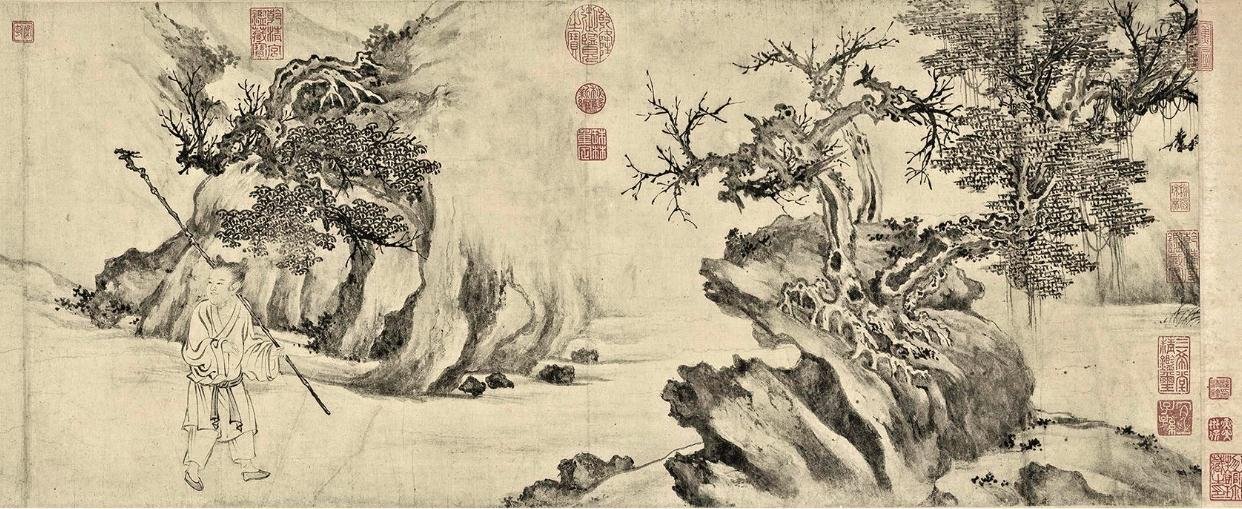
The Bishan Poetry Society’s account of itself cannot be separated from ancient stories of fellowship. In his colophon to the Painting of the Bishan Poetry Society (Figure 4), Shen Zhou first cited the White Lotus Society of Huiyuan (Figure 2), writing, “The Reverend Yuan of Mount Lu founded the Lotus Society, and Yuanming and Xuandu were in its company; this was the glory of a thousand ages”, and continued, “The ten elders of Liangxi have imitated them and built a hall on the sunny slope of Mount Hui”.26 The precedent of the White Lotus Society links monastery, mountains and forests, scholars, and monks, and it suits the setting of the Listening to the Pines Hermitage perfectly. Wang Da had already used the phrase “the Reverend Yuan planting lotuses” in his Preface to Pure Poems on the Bamboo Stove, and Wang Fu’s poem on the stove has the line “the old Chan monk entrusted it with reopening the society”. The White Lotus Society was thus more than a generic allusion to lofty men. It could join the early Ming exchanges of Xinghai and Wang Fu at the Listening to the Pines Hermitage with the Bishan Poetry Society of the Chenghua years.
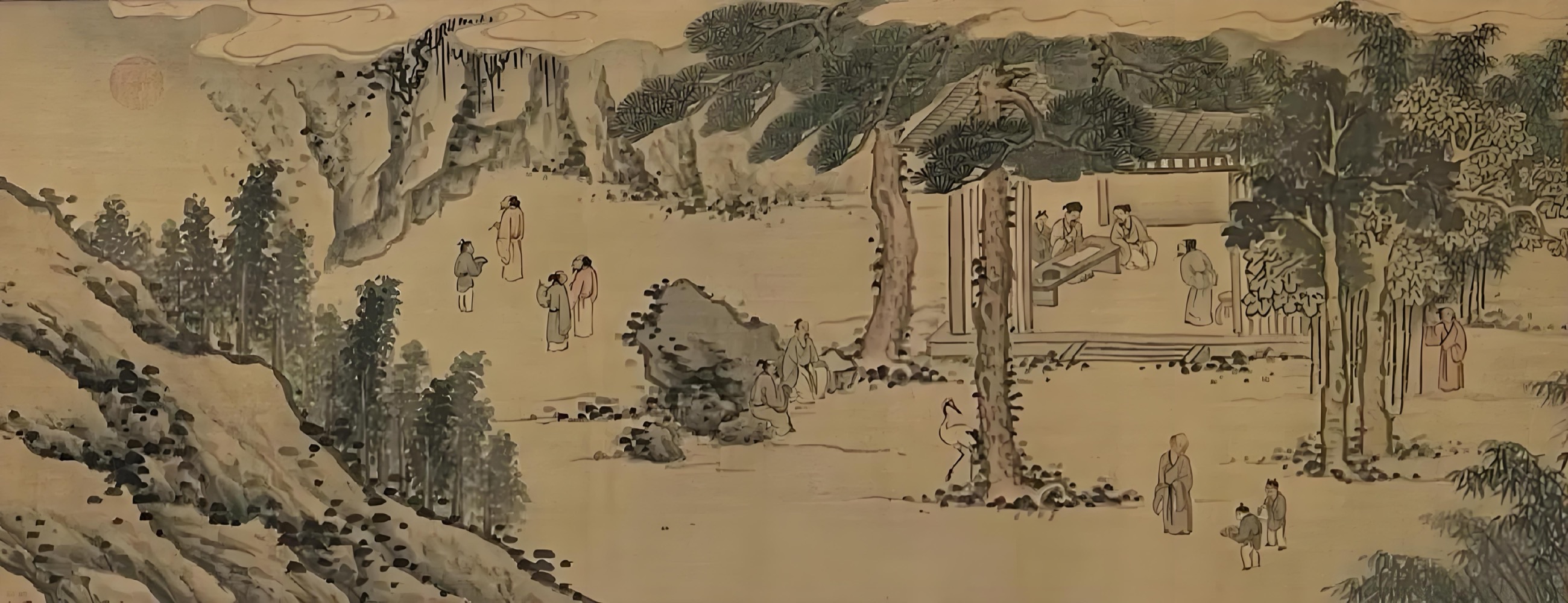
The prefaces and colophons of the society nonetheless draw more often on the societies of Xiangshan and Luoyang. Zhang Kai placed Bai Juyi’s 白居易 Nine Elders of Xiangshan (Figure 3) alongside the ten elders of Bishan, the former living “at the moment of merit accomplished and self withdrawn”, the latter “singing of peace in days when those above are tranquil and those below serene”. Qin Kui likewise wrote in a poem presented to the company, “Their talents suffice to carry on the glory of Xiangshan”, adding, “I too am weary now of wandering in office, and would gladly keep company with the yellow-haired among fishermen and woodcutters”.27 The emphasis here falls first on great age, second on withdrawal from office, and third on the pleasures of poetry and wine. The Xiangshan precedent gave an orderly name to a local gathering whose members differed in age and station, and it also accommodated the imagination of serving officials about life after return to the fields.

The Painting of the Bishan Poetry Society (Figure 4) by Shen Zhou lifted the ten elders out of the scene of their monthly meetings, preserving their features, their seats, and the surroundings of Mount Hui, while his colophon placed this local gathering within the succession of fellowships through the ages. Wang Yu, examining Shen Zhou’s associations at Mount Hui, has noted his dealings with Qin Kui, which provides a traceable line for the genesis of the painting.28 Shen Zhou’s involvement in the Wuxi society’s affairs thus came through Qin Kui and through the local network of painting and calligraphy; it was no intervention out of nowhere. Since Zhang Kai already identified the story of the Nine Elders of Xiangshan (Figure 3) as the model the Bishan Poetry Society imitated, the historical circumstances of that model demand our attention. In the fifth year of the Huichang era of Emperor Wuzong of Tang (845), Bai Juyi resigned his office as Minister of Justice, bought the grounds of the former Xiangshan Monastery within the city of Luoyang, and gathered there with eight friends in elegant assembly, forming what was called the Society of the Nine Elders, whence the name “Nine Elders of Xiangshan”. His reason for resigning and retiring was to escape a perilous court in which eunuchs wielded power and factional strife never ceased.
The Painting of the Bishan Poetry Society (Figure 4) was very likely made under the inspiration of Elegant Gathering in the Apricot Garden (Figure 1). In 1477, after viewing the Apricot Garden scroll in the capital, Ni Yue and his companions asked a painter to make the Gathering of Hanlin Graduates of the Same Year, as Ni Yue’s own record attests.29 Wu Kuan, Li Dongyang, and others afterward organized repeated gatherings of fellow townsmen and of men of the same examination year. This shows that scholars of the Chenghua period were familiar with the commemorative sequence of gathering, portraits, inscriptions, and the making of a scroll. Shen Zhou never saw the Apricot Garden painting himself, yet he could well have learned of it, of the Hanlin same-year picture, and of the deeper meanings behind them through his close friend Wu Kuan. Because Shen Zhou had seen Song versions of The White Lotus Society (Figure 2) and The Nine Elders of Xiangshan (Figure 3) in the collecting circles of Jiangnan, his painting drew its formal vocabulary, in all likelihood, from those Song works, and any debt to Elegant Gathering in the Apricot Garden (Figure 1) remains unproven. Whether or not Shen Zhou knew of the political expression hidden in the Apricot Garden and the same-year pictures and put it to use in his own painting, for the local gentry of Wuxi such pictures had already become one available way of voicing their own ideals.
Objects, Scrolls, and Paintings in the Shared Fashioning of Mount Hui
Read together, the bamboo stove and the poetry society show that the space of Mount Hui was no static backdrop to cultural activity. It was affirmed again and again in the return of the object, the deposit of the scrolls, the building of the society’s quarters, and the making of the painting. The Listening to the Pines Hermitage kept both the old poems and the new poems of the recovered stove. The Second Spring supplied the irreplaceable water for brewing tea. The Bishan Poetry Society set its gate, hall, and pavilion beside the spring. Object and buildings thus shared a single stock of place names, persons, and stories. Even where poems were produced in Beijing, the finished scrolls pointed back to Mount Hui. Even though Shen Zhou seldom kept company with the ten elders, what his picture painted took the society’s gatherings at Mount Hui as its subject.
On obtaining the stove, Qin Kui returned it to the Listening to the Pines Hermitage, declining to keep it in his own household, and when the capital scroll was complete it too was given to the monks for safekeeping. The return of the old object and of the poem scroll turned a mobilization of personal obligation into a local monument. Sheng Yu’s replicas show further that this meaning no longer belonged to one original object alone. So long as the form, the naming, and the web of poems endured, the bamboo stove could enter new spaces and new communities. Once the poems and portraits had been arranged, mounted, and inscribed afresh, they lasted far longer than any single tea gathering or society meeting, so that Shao Bao, Qian Fu, and Lu Jian in later years could still append prefaces and colophons and reinterpret what had gone before. These objects and scrolls moved from hand to hand, yet always with the Listening to the Pines Hermitage, the Second Spring, and the Bishan quarters as their destination, and Mount Hui grew from a celebrated spring and scenic spot into a literati space possessed of a genealogy.
In this process, local reputation and personal reputation drew strength from one another. Qin Kui used Wang Fu’s name to recover the stove, and in recovering it and soliciting poems he left behind a local accomplishment of his own. Sheng Yong used the “Lord of Bitter Integrity” to declare his aspirations, while the stove gained its meaning of steadfastness from his official career. The ten elders entered the wider scholarly world through the plaques, poems, and paintings of famous outsiders, and those who made the presentations used the old precedents of Xiangshan and the White Lotus to lodge their own imaginings of withdrawal. Zhang Kai’s dictum that “a thing does not make itself precious” and Chen Qiong’s picture of “the scholarly grove hearing with delight” together reveal that reputation belongs to no object or person singly. It is generated in repeated inscription and mutual judgment.
This web of relations also shows why the phrase “local cultural capital”, though it describes the outcome well enough, cannot explain the process. The participants were doing more than adding famous stories to Wuxi; they were managing their own situations. Men in mourning needed to settle a life temporarily withdrawn from office within their home district. The retired needed to preserve the renown of their years in office. Those still serving used the imagination of return to the fields to balance court and marketplace against forests and springs. Commoner physicians and scholars used the society’s gatherings to confirm their standing in the locality. Mount Hui could hold these needs together exactly because it lay near the city and its routes of travel while also possessing a famous spring, monasteries, and the traces of former worthies, a place where local life and the experience of the court could meet in one spot.
Seen in this light, the political meaning of these undertakings does not lie in hunting out a common program concealed behind the lines of verse. What the bamboo stove and the poetry society maintained was an order of judgment about who could be a friend, what manner of life could be called pure, and how a man should conduct himself between office and withdrawal. Such judgments were closely tied to experience of officialdom, and at particular moments they could become grounds for criticizing the powerful. The evidence in Sheng Yong’s case is relatively strong. Qin Kui’s recovery of the stove and the founding of the Bishan society chiefly display the organization of a local cultural lineage and of a network of association. Only by distinguishing these several levels can we see both that cultural activity was never unconnected to politics and that refined amusement cannot all be written as cipher.
伍Conclusion
The exchanges on the recovery of the bamboo tea stove and the founding of the Bishan Poetry Society in Chenghua-era Wuxi appear on the surface as two local cultural events, one of a stove and one of a society, yet they shared a single network of persons and a single stock of symbolic resources. The narrative of the bamboo tea stove was rewritten continually over several decades. Wang Fu, one participant among the original company of inscribers, was pushed step by step into the position of the stove’s maker, and his persona of “lofty integrity beyond the vulgar”, built on the steely and unbending groundwork of the biographies written by his contemporaries and exalted through Ye Sheng’s anecdote of the flute heard beneath the moon, was bound fast to the stove as an object, so that it became a spiritual token that locality and family alike could hand down. Through the recovery and the exchanges, Qin Kui restored a local monument and prolonged the cultural line of Mount Hui. Sheng Yong, through the inscription “Lord of Bitter Integrity”, lodged his resolve in the object, taking his own experience of impeaching Shi Heng and Cao Jixiang and enduring demotion without yielding as his ground, and conducted with Wu Kuan, Li Dongyang, and the other Hanlin lecturers who would soon hold the future of the court in their hands a transmission of spirit across the generations. The ten commoner elders of the Bishan Poetry Society, through a network in which their sons, brothers, and marriage kin mostly held eminent posts, drew an unbroken stream of presentations from the leading figures of an age, Wang Shu, Wang Ao, Wu Kuan, and the rest, so that the classical ideal of Xiangshan and Luoyang was practiced by a circuitous path, in the form of a local society, beneath the realities of eunuch usurpation.
Returning here to Yin Ji’nan’s observation about Elegant Gathering in the Apricot Garden (Figure 1), that the gathering pictures of Beijing officials in the mid-fifteenth century were in fact “a political painting deeply harboring the antagonistic complex between civil officials and eunuchs”, the Wuxi case shows that this undercurrent existed beyond the gatherings of capital officials and reached into local society. The bamboo stove, the poetry society, and the aspiration toward forests and springs were at once the cultivation of cultural capital and, in a context of disordered court government, the means by which a gentry community sustained its shared values, admonished its juniors, and curated local memory. The Second Spring of Mount Hui won empire-wide fame through Lu Yu’s grading of waters, and through the bamboo tea stove and the Bishan Poetry Society it became a cultural space written and overwritten, layer upon layer, by the gentry network. The three scrolls of the New Poems on the Bamboo Stove are kept at the Listening to the Pines Hermitage and with the Sheng family, while a single painting of the Bishan Poetry Society (Figure 4) has circulated in the world of art. Object, text, image, and place here made one another whole.
Notes
- 1.Yin Ji’nan 尹吉男, “Zhengzhi haishi yule: Xingyuan yaji he Xingyuan yaji tu xin jie” 政治还是娱乐:杏园雅集和《杏园雅集图》新解 [Politics or amusement: The Apricot Garden gathering and its painting, a new interpretation], Gugong bowuyuan yuankan 故宫博物院院刊 [Palace Museum Journal], no. 1 (2016): 6–39. ↩
- 2.Wang Da 王達, “Zhu lu ji” 竹爐記 and “Zhu lu qingyong xu” 竹爐清詠序, in Zhu lu tuyong 竹爐圖詠, comp. Wu Yue 吳鉞, vol. 4 of Xishan xianzhe congkan 錫山先哲叢刊 (Zhonghua shuju, 1922), heng 亨 collection, 1a–4b; see also Tan Xiu 談修, comp., Huishan gujin kao 惠山古今考 (Wanli-era woodblock ed.), juan 3. ↩
- 3.Qin Kui 秦夔, “Fu zhu chalu ji” 復竹茶爐記, in Huishan gujin kao, juan 3; Lu Jian 陸簡, “Fu zhu chalu ji,” in the same juan. ↩
- 4.Shao Bao 邵寶, “Xu zhu chalu” 序竹茶爐, in Rongchuntang ji 容春堂集, juan 2, 1a–b. Elsewhere in the manuscript tradition the title is written with xu 敘; this article follows the juan heading of Rongchuntang ji in writing xu 序. ↩
- 5.Inscriptions by Sheng Yong 盛颙 and Wu Kuan 吳寬, in Zhu lu tuyong, yuan 元 collection, 1a–2a. ↩
- 6.Wang Hong 王洪, “Wang Mengduan xiaozhuan” 王孟端小傳, appendix to Wang sheren shiji 王舍人詩集, in Xishan xianzhe congkan 錫山先哲叢刊, vol. 2 (Zhonghua shuju, 1922), 319–20; Zhang Bingru 章昞如, “Gu Zhongshu sheren Wang Mengduan gong xingzhuang” 故中書舍人王孟端公行狀, appendix to the same work, 321–23. ↩
- 7.Hu Guang 胡廣, “Zhengshilang Zhongshu sheren Wang Mengduan mubiao” 徵事郎中書舍人王孟端墓表, appendix to Wang sheren shiji, 326–27; Hu Guang, “Wei Yang shuzi ti Wang Zhongshu Mengduan xie zhu” 為楊庶子題王中書孟端寫竹 and “Ti Wang Zhongshu Mengduan wei Yang shuzi hua zhuzhang ge” 題王中書孟端為楊庶子畫竹障歌, in Hu Wenmu gong wenji 胡文穆公文集, juan 3 and juan 4. ↩
- 8.Ye Sheng 葉盛, “Wang Mengduan yishi” 王孟端遺事, in Shuidong riji 水東日記, juan 1 (Zhonghua shuju, 1980), 10. ↩
- 9.Zhang Bingru, “Gu Zhongshu sheren Wang Mengduan gong xingzhuang,” 321–23. The present summary of Wang Fu’s movements between office and reclusion relies solely on the early biographies; the story of his refusing the Duke of Qian’s request for a painting, which accrued layer upon layer from the late Ming onward, is not treated here as a fact of his own time. ↩
- 10.Qin Kui, “Fu zhu chalu ji.” ↩
- 11.Colophon by Qin Kui, in Zhu lu tuyong, zhen 貞 collection, 13a–14a. ↩
- 12.Colophon by Wu Kuan, in Zhu lu tuyong, yuan collection, 1a–2a; Li Dongyang 李東陽, “He Sheng Shunchen xinzhi zhu chalu” 和盛舜臣新製竹茶爐, in Huishan ji 惠山記, ed. Shao Bao, juan 3. ↩
- 13.For the poems and inscriptions of Wu Kuan and those after him, see Zhu lu tuyong, yuan collection. On Sheng Yong’s career, see Qiu Jun 丘濬, “Duchayuan zuo fu duyushi Sheng gong Yong muzhiming” 都察院左副都御史盛公颙墓誌銘, in Guochao xianzheng lu 國朝獻徵錄, juan 60; and Zhang Tingyu 張廷玉 et al., Ming shi 明史, juan 162, “Yang Xuan zhuan” 楊瑄傳, with the appended biography of Sheng Yong. ↩
- 14.Ni Yue 倪岳, “Hanlin tongnian hui tu ji” 翰林同年會圖記, in Qingxi mangao 青溪漫稿, juan 16. ↩
- 15.Colophon by Chen Qiong 陳璚, in Zhu lu tuyong, yuan collection, 5a–6b. ↩
- 16.Sheng Yong, “Kujiejun ming” 苦節君銘, in Zhu lu tuyong, yuan collection; see also Gu Yuanqing 顧元慶, Cha pu 茶譜, in Xuxiu siku quanshu 續修四庫全書, vol. 1115 (Shanghai guji chubanshe, 1995–2002), 218. ↩
- 17.Ming Yingzong shilu 明英宗實錄, juan 274, entry for the gengzi day of the sixth month in the first year of Tianshun; Zhang Tingyu et al., Ming shi, juan 162, “Yang Xuan zhuan.” ↩
- 18.Qiu Jun, “Duchayuan zuo fu duyushi Sheng gong Yong muzhiming.” Qiu Jun writes that Sheng Yong “first plotted with his colleague Zhang Peng of Laishui”; the Ming Yingzong shilu records only that “the investigating censors of the thirteen circuits, Zhang Peng and others, joined in a memorial.” This article therefore treats Sheng Yong’s role as originator as a retrospective account preserved in the epitaph, and not as undisputed fact. ↩
- 19.Sheng Yong’s three inscribed poems are in Zhu lu tuyong, yuan collection, 4b. “The Immortal Lu” in the verses refers to Lu Tong 盧仝. ↩
- 20.Guangxu Wuxi Jinkui xianzhi 光緒無錫金匱縣志, juan 25, “Yinyi zhuan” 隱逸傳, entries on Qin Xu 秦旭 and Li Shu 李庶. The sources vary on Qin Xu’s courtesy name, writing it Jingyang 景暘 or Jingyang 景昜, and give him the sobriquet Xiujing 修敬; the main text uses his given name only. ↩
- 21.Zhang Kai 張愷, “Bishan yinshe ji” 碧山吟社記, in Huishan gujin kao, juan 4. ↩
- 22.On Chen Mian, see Kangxi Changzhou fuzhi 康熙常州府志, juan 30. On Yang Li’s family and life, see Wang Ni 王㒜, “Changhe shouci houti” 唱和壽詞後題, in Sixuan wenji 思軒文集, juan 11. On Shi Lian and Li Shu, see Guangxu Wuxi Jinkui xianzhi, juan 25. On the Pan family, see Qin Kui, “Shanggu chushi Pan jun mujieming” 尚古處士潘君墓碣銘, in Wufeng yigao 五峰遺稿 (Jiajing-era woodblock ed.), juan 21. ↩
- 23.Qin Kui, “You Yang Tingyu Nanhu caotang shi yin” 游楊聽玉南湖草堂詩引, in Wufeng yigao, juan 22. The preface records that in the fourth month of the sixteenth year of Chenghua (1480), Yang Li invited Huang Lu, Gao Zhi, Chen Gongmao, Shi Lian, Pan Xu, and others on the excursion. ↩
- 24.Qin Kui, “Xianjun Zhenjing xiansheng xingshi” 先君貞靖先生行實, in Wufeng yigao, juan 18. ↩
- 25.Shao Bao, “Ba Bishan yinshe shijuan” 跋碧山吟社詩卷, in Huishan gujin kao, juan 4; Li Ying 李郢, “Bishan yinshe yaji tu ji” 碧山吟社雅集圖記, in the same juan. ↩
- 26.Shen Zhou 沈周, colophon to Bishan yinshe tu 碧山吟社圖, transcribed in Huishan gujin kao, juan 4. The transcription reads, “The Reverend Yuan of Mount Lu founded the Lotus Society, and Yuanming and Xuandu were in its company . . . The ten elders of Liangxi imitated them and built a hall on the sunny slope of Mount Hui, naming it the Bishan Poetry Society.” ↩
- 27.Zhang Kai, “Bishan yinshe ji”; Qin Kui, “He Bishan yinshe xincheng yun” 和碧山吟社新成韻 and “Zeng Bishan yinshe zhugong” 贈碧山吟社諸公, in Wufeng yigao, juan 8. ↩
- 28.Wang Yu 王瑀, Shen Zhou shihua zhong de Jiangnan 沈周詩畫中的江南 [Jiangnan in Shen Zhou’s poetry and painting] (Beijing daxue chubanshe, 2022), 138, 149. ↩
- 29.Ni Yue, “Hanlin tongnian hui tu ji.” The record states explicitly that in the dingyou year of Chenghua someone in the company produced the Elegant Gathering in the Apricot Garden scroll, whereupon those present had a painter make their portraits into a painting. ↩
Image credits
- Figure 1. Elegant Gathering in the Apricot Garden 杏園雅集圖, attributed to Xie Huan 謝環 (fl. early 15th c.). Handscroll, ink and colour on silk, 43.5 × 210.5 cm, dated 1437. Collection of the Zhenjiang Museum, Jiangsu 鎮江博物館藏.
- Figure 2. The White Lotus Society 白蓮社圖, attributed to Zhang Ji 張激 (Northern Song), formerly attributed to Li Gonglin 李公麟. Handscroll, ink on paper. Collection of the Liaoning Provincial Museum 遼寧省博物館藏.
- Figure 3. The Nine Elders of Huichang 會昌九老圖, also known as The Nine Elders of Xiangshan 香山九老圖. Song dynasty (Southern Song), anonymous. Handscroll, ink and colour on silk, 28.2 × 245.5 cm. Collection of the Palace Museum, Beijing 北京故宮博物院藏.
- Figure 4. Painting of the Bishan Poetry Society 碧山吟社圖, attributed to Shen Zhou 沈周 (1427–1509). Handscroll, ink and colour on silk, 31.7 × 206 cm. Collection of the Capital Museum, Beijing 首都博物館藏. Institutions differ over the present location of this scroll; the attribution follows the holding stated in the Palace Museum’s publication of the painting.
- Lost works. Three works discussed in the text do not survive and are therefore not illustrated: the Gathering of Hanlin Graduates of the Same Year (1477; known through Ni Yue’s record), Wang Fu’s painting of Mount Lu for the monk Xinghai at the Listening to the Pines Hermitage (recorded by Shao Bao), and the painting of bamboo and rocks that Wang Fu gave the flutist and later tore up (Ye Sheng, Diary of the East Waters).
- Images are reproduced here for scholarly commentary and identification. Copyright and reproduction rights remain with the holding institutions; images were supplied by the author.
Bibliography
- Guangxu Wuxi Jinkui xianzhi 光緒無錫金匱縣志.
- Gu Yuanqing 顧元慶. Cha pu 茶譜. In Xuxiu siku quanshu 續修四庫全書, vol. 1115. Shanghai guji chubanshe, 1995–2002.
- Hu Guang 胡廣. Hu Wenmu gong wenji 胡文穆公文集.
- Kangxi Changzhou fuzhi 康熙常州府志.
- Li Ying 李郢. “Bishan yinshe yaji tu ji” 碧山吟社雅集圖記. In Huishan gujin kao, juan 4.
- Ming Yingzong shilu 明英宗實錄.
- Ni Yue 倪岳. Qingxi mangao 青溪漫稿.
- Qin Kui 秦夔. Wufeng yigao 五峰遺稿. Jiajing-era woodblock edition.
- Qiu Jun 丘濬. “Duchayuan zuo fu duyushi Sheng gong Yong muzhiming” 都察院左副都御史盛公颙墓誌銘. In Guochao xianzheng lu 國朝獻徵錄, juan 60.
- Shao Bao 邵寶. “Ba Bishan yinshe shijuan” 跋碧山吟社詩卷. In Huishan gujin kao, juan 4.
- Shao Bao 邵寶. Rongchuntang ji 容春堂集.
- Shao Bao 邵寶, ed. Huishan ji 惠山記.
- Shen Zhou 沈周. Colophon to Bishan yinshe tu 碧山吟社圖. In Huishan gujin kao, juan 4.
- Tan Xiu 談修, comp. Huishan gujin kao 惠山古今考. Wanli-era woodblock edition.
- Wang Da 王達. “Zhu lu ji” 竹爐記. “Zhu lu qingyong xu” 竹爐清詠序. In Wu Yue, Zhu lu tuyong.
- Wang Hong 王洪, and Zhang Bingru 章昞如. Appendixes to Wang sheren shiji 王舍人詩集. In Xishan xianzhe congkan 錫山先哲叢刊, vol. 2. Zhonghua shuju, 1922.
- Wang Ni 王㒜. Sixuan wenji 思軒文集.
- Wang Yu 王瑀. Shen Zhou shihua zhong de Jiangnan 沈周詩畫中的江南. Beijing daxue chubanshe, 2022.
- Wu Yue 吳鉞, comp. Zhu lu tuyong 竹爐圖詠. Vol. 4 of Xishan xianzhe congkan 錫山先哲叢刊. Zhonghua shuju, 1922.
- Ye Sheng 葉盛. Shuidong riji 水東日記. Zhonghua shuju, 1980.
- Yin Ji’nan 尹吉男. “Zhengzhi haishi yule: Xingyuan yaji he Xingyuan yaji tu xin jie” 政治还是娱乐:杏园雅集和《杏园雅集图》新解. Gugong bowuyuan yuankan 故宫博物院院刊, no. 1 (2016): 6–39.
- Zhang Kai 張愷. “Bishan yinshe ji” 碧山吟社記. In Huishan gujin kao, juan 4.
- Zhang Tingyu 張廷玉 et al. Ming shi 明史.
End of essay · NOUS Review