1Introduction: Transpacific Sensory Politics
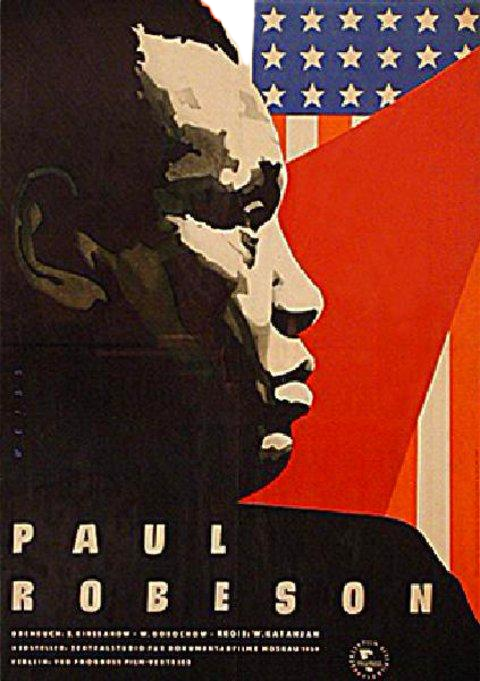
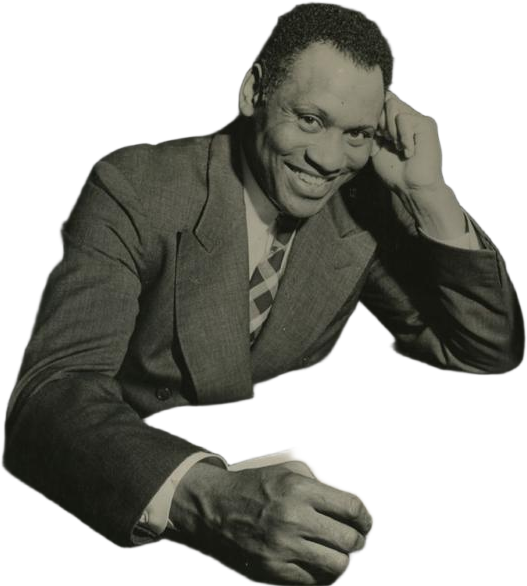
History often reveals its urgency through stories of voices that dare to cross boundaries. In mid-20th century New York, African American singer and activist Paul Robeson raised his voice in flawless Chinese to sing the Chinese national anthem “March of the Volunteers.” For the six thousand people who witnessed it, Robeson’s performance was not simply a cultural exchange or aesthetic novelty; it was a deliberate political intervention that unsettled the racialized order of listening in Cold War America, a moment in which sound itself became a claim to public presence and political solidarity. This essay takes that moment as its entry point to examine how, between the 1930s and the 1970s, African American artists translated the sonic and visual idioms of Chinese revolutionary culture into a distinctive Black resistance aesthetic that sought the right to be heard and the right to be seen.
In the mid‑twentieth century, African American artists looked across the Pacific to China and found, in its revolutionary symbols, a language for their own struggle for freedom. Through the resonant songs of Paul Robeson, the visual strategies employed in the Black Panther Party’s reproduction of Chinese revolutionary iconography, and the poetry of Langston Hughes, they claimed the right to be heard, invented new modes of visibility, and discerned “third spaces” where cross‑racial solidarity could take root. In doing so, they challenged the United States’ racialized “distribution of the sensible,” turning art into a transnational political aesthetic that linked Black liberation to global anti‑imperial movements. This project of negotiation, productivity, and hybridity left behind not only works of art but also a transpacific legacy of sensory emancipation.
The core of this study lies in repositioning transnational cultural exchange from the level of ideas to the sensory level. Building on Jacques Rancière’s notion of the “distribution of the sensible,” I introduce the concept of sensory segregation to name the U.S. racial regime that governs who may be audible or visible, and how those senses are interpreted and policed. Against this background, mid-20th-century China articulated a contrasting politics of the senses: mass songs, posters, and spectacles that explicitly organized sound and sight as resources for collective mobilization. When Chinese revolutionary iconography circulated across the Pacific, they did not translate passively. African American performers, poets, and visual producers reworked these forms to contest the boundaries of audibility and visibility imposed by U.S. racial orders, producing a set of practices I analyze as a transpacific sensory politics.
To capture the mechanisms through which these cross-cultural translations operated, I propose a three-stage analytical framework (N–P–H model): negotiation, productivity, and hybridity. Negotiation denotes strategic interventions into the auditory order: practices that attempt to convert “noise” into legitimate speech or song, thereby claiming a right to be heard. Productivity refers to the active making of new visual grammars and media forms for visibility, including the formatting, layout, and circulation practices that render formerly invisible subjects legible as political actors. Hybridity names the third spaces in which distinct sensory concepts are braided together to produce new collective perceptions and solidarities. Together, the N–P–H model explains not only the influence of Chinese revolutionary signs but how they were strategically manipulated across different sensory registers to reconfigure the African American political presence.
Empirically, the research paper mobilizes three case studies that exemplify each stage of the model. Paul Robeson’s multilingual performances and recording projects embody negotiation in the acoustic register; his use of Chinese song unsettled the listening habits of the Anglophone world and momentarily displaced the sonic color line. The Black Panther Party demonstrates productivity through visual practice. By reworking Maoist poster aesthetics and slogan forms into Panther layouts and street spectacles, the Party produced powerful visible claims on public space and political dignity. Langston Hughes’s poems and public interventions illustrate hybridity. His transoceanic imagery forges a poetic third space that links anti-colonial struggles with African American demands, producing affective bonds across distance. These artistic acts are analyzed in tandem with the state countermeasures, such as passport revocations, Counter Intelligence Program (COINTELPRO), and House Un-American Activities Committee (HUAC) interrogations, that sought to reseal the sensible. They reveal a dynamic contest in which the push for new sensory freedom continually met by the state’s coercive efforts to contain them, shaping an ongoing struggle over sensory politics.
Methodologically, the study combines archival research, close reading of literary and visual texts, and media history analysis of circulation practices (records, newspapers, journals, posters). The materials reproduce a distinct archive from concert programs and records to newspaper layouts and poems, precisely because the politics I describe traverse media and modalities. Sound, print, and image each functions as a site of contestation over presence and meaning.
This project contributes in three main ways. First, it reconstructs a neglected transpacific circuit of cultural exchange in which Chinese revolutionary aesthetics functioned as resources for African American political imagination. Second, it reframes cross-cultural borrowing as a processual politics of the senses, articulated through the N–P–H model, rather than as simple influence or imitation. Third, it connects historical practices to contemporary debates about representation and public space by arguing that struggles over who may be heard and seen remain critical to cultural politics. The paper proceeds as follows: section two traces the historical and media circuits that carried Chinese revolutionary symbols to U.S. shores; section three elaborates the theoretical frame; section four analyzes the three case studies; section five examines state backlash and contraction; and the conclusion probes the legacy and contemporary reverberations of transpacific sensory politics.
2Historical Context: Distribution of the Sensible, Double Sensory Confinement, and the Flow of Transnational Revolutionary Symbols
2.1Political Aesthetics and “Sensory Segregation”
In The Politics of Aesthetics, French philosopher Jacques Rancière introduces the concept of “distribution of the sensible,” which is not only an aesthetic theory but also a political tool for analysis. For him, art matters politically because it can intervene in and redraw the sensible order: “Artistic practices are ‘ways of doing and making’ that intervene in the general distribution of ways of doing and making as well as in the relationships they maintain to modes of being and forms of visibility” (Rancière 13).
In this sense, the “distribution of the sensible” is the institutional division in society of what can be seen and what can be heard, a division that inherently involves power dynamics about who has the right to speak in public space, whose image is given meaning, and whose existence is systematically ignored. Even when African Americans are physically present, their voices are often muted or distorted and their images reduced to stereotypes, which, as scholar Jennifer Lynn Stoever notes, “makes palpable the visual representational processes that render black people either invisible or hypervisible, but never truly seen and known” (9). This sensory deprivation pushes them to the margins and confines their ways of expression.
Building on these, a theoretical framework of “sensory segregation” is used in this essay to describe the U.S. racial order: a regime that exceeds spatial separation to govern perception itself—controlling who is audible and visible, degrading some voices to “noise,” and fixing images through stereotypes. This framework will guide the following analysis of how African American artists translated Chinese revolutionary symbols to reshape a racialized sensory field in the United States.
2.2Racial “Sensory Segregation” in the United States
2.2.1The Control of Auditory Order
In the first half of the twentieth century, U.S. cultural industries subjected Black and white music to starkly different regimes of production and circulation. As Stoever observes:
Frustratingly, African Americans did find themselves listening in as white American broadcasters, networks, advertisers, radio stations, writers, casting agents, musicians’ and actors’ unions, newspaper critics, and media theorists excised them from contemporary conversations about radio and its role in shaping “modern” citizens. (Stoever 231)
Within Black communities, spirituals, blues, and jazz carried deep political memories and meanings of resistance. Yet when these genres entered white-dominated entertainment markets, their political edge was routinely stripped away, changed into softer, sentimental performances designed for leisure. Black music was thus recast as consumable and non-threatening, tailored to the white audience majority’s aesthetic tastes and political safety zones.
Within this structure, sound itself became a key instrument of racial differentiation. As Stoever notes, “the sonic color line enabled the dominant white culture to classify particular sounds as identifiably and essentially ‘black’” (36), coding Black voices as emotional and unpredictable rather than neutral public expression.
Stoever further underscores that this process regulated not only sound but also listening itself: “Tethering both an evolving battery of sounds and a limited range of listening practices to black bodies expanded white racism to include new forms of acoustic disciplining,” she argues, “that punished racial transgressions and served as violently coercive psychological conformity” (36). Here, “acoustic disciplining” refers to the broader system of auditory control through which the dominant culture trained listeners to hear Black voices in narrowly racialized ways, while punishing sounds that transgressed those boundaries. Even when African Americans were physically present in public space, their voices were often muted, distorted, or reclassified as “noise” or “entertainment.”
This form of auditory segregation illustrates a broader logic of “sensory segregation.” It curtailed African Americans the full audibility of their cultural expression and enforced psychological conformity through listening practices designed to uphold racial hierarchies. Overcoming such regimes thus requires a redistribution of the sensible, one that makes suppressed voices to be heard as legitimate contributions to the cultural and political commons.
2.2.2The Discipline of Visual Order
Alongside auditory control, Black visual representation has long been governed by racialized logics of visibility. Saidiya Hartman urges attention to the everyday scenes where power naturalizes itself: “We do better to cast our glance at the more mundane displays of power and the border where it is difficult to discern domination from recreation. By disassembling the ‘benign’ scene, we confront the everyday practice of domination, the daily routine of terror, the non-event, as it were” (Hartman 66). These “benign” spectacles such as coerced entertainments, staged dances, and curated pleasures install a visual order that renders domination ordinary.
As the article succinctly puts it, “The Saturday games at plantation house acted as a productive force that regulated the forms of expression allowed to the dominated” (Pereira). In other words, visibility is not merely reflective but productive. It manufactures permissible gestures and affects, dictating the very terms of appearance.
The slave trade revealed this logic in its starkest form. The act of display forced victims to appear as if they were willing participants, a performance meant to render the transaction orderly and respectable. As Hartman notes, “To ‘make themselves sellable,’ the captives chained by the neck were forced to sing Old Virginia Never Tire . . . whose essential function . . . was to make the subjugated appear content and comfortable” (Hartman 49). In this cruel staging, joy and suffering were placed side by side, with a mask of cheerfulness imposed to obscure the violence beneath.
The crucial question of visual politics, then, is how to dismantle the scenes in which violence remains unseen. Hartman’s provocation is blunt: “Is the perfect picture of the crime the one in which the crime goes undetected?” (66). This challenge aligns with the paper’s broader account of sensory segregation: even when Black bodies appear in public imagery, they are contained within visual regimes that foreclose speech and deny agency.
2.3The Sensory Politics of Chinese Revolutionary Symbols and Their Transnational Dissemination
In stark contrast to the racialized sensory segregation in the United States, China developed a sensory politics of revolutionary culture during the mid-20th century. This model used sound and vision as tools for political mobilization while emphasizing direct mass participation.
2.3.1The Acoustic Power of Revolutionary Music
Unlike the U.S. racial regime of “sensory segregation,” 1930s China developed a musical politics centered on mobilization. The “March of the Volunteers” became one emblem. As Howard notes, “‘March of the Volunteers’ created a new national style characterized by its robust, resonant, heroic, and powerful sound—a fervent, vigorous quality previously unknown to Chinese songs” (136). This unprecedented sound turned music into a political force.
Its power lay in merging local and global traditions. Howard emphasizes, “the success of ‘March of the Volunteers’ lay in Nie Er’s ability to use the Chinese musical foundation while incorporating compositional techniques from foreign revolutionary songs and marches . . . ” (Howard and Lau 136). By blending labor chants, folk-like melodies, and Soviet “mass song” rhythms, it resonated throughout China and internationally.
These “mass songs” were crafted as tools of collective action. Howard observes that the National Salvation Song Movement positioned song as its primary vehicle for mobilizing national solidarity, and that “it was Nie’s ‘mass songs’ that formed the canon of socially accepted art” (137). The anthem exemplified a sonic politics that ordinary people could readily adopt and perform.
2.3.2The Dissemination and Political Significance of Chinese Revolutionary Visual Symbols
If the “March of the Volunteers” embodied sonic mobilization, Chinese revolutionary culture also built a politics of the senses through a visual system. From the 1950s, China projected images of workers, peasants, and soldiers and set against red backdrops and bold slogans through journals like China Pictorial and events such as the World Festival of Youth and Students (WFYS). As Wilcox notes, the WFYS “was an important platform for cultural exchange among the global left” (35), enabling Chinese artists to present their works and forge ties with foreign communities. Posters, performances, and photographs not only conveyed anti-imperialist and anti-colonial messages but also modeled a collectivist aesthetic that stood in sharp contrast to Western individualism.
These visual practices were circulated not only on stage but also through widely distributed print. China Pictorial regularly published images of dances and collective formations, such as “Red Silk Dance in Moscow,” originally published in China Pictorial (Renmin huabao) 1952, No. 1 (Wilcox 35). Through images and performances, revolutionary aesthetics became powerful resources for international leftist solidarity.
At the same time, the Beijing Review targeted global readers with both text and images. As Terrell explains, it was “intended for foreign consumption” (193), reaching subscribers in more than 150 countries, from intellectuals to diplomats. This circulation extended revolutionary imagery into transnational spaces, where it made its way to African American radicals seeking alternatives to the racialized visual order of the United States. Chinese revolutionary symbols conveyed political content while simultaneously offering a sensory template for imagining new forms of collective visibility.
2.3.3The Re-signification of Symbols Across Oceans
Chinese revolutionary symbols acquired new meanings when they entered the United States. For African American artists under racialized “sensory segregation,” their mass-oriented and anti-imperialist qualities offered an alternative model for expression beyond the confines of white-dominated culture.
For example, when Paul Robeson sung the “March of the Volunteers” with its robust sonic style noted by Howard (136), the performance transcended the original Chinese context and reanimated the anthem as part of a global repertoire of resistance, aligning its heroic resonance with anti-racist and anti-colonial struggle. This transformation illustrates how revolutionary symbols circulated across borders not as static artifacts but as mutable resources actively re-signified in challenging oppressive sensory regimes.
3Theoretical Framework: From Sensory Subversion to the Creation of Third Space
In section 2, we observed the stark contrast between the racialized “sensory segregation” in the United State and China’s emphasis on the “participatory” nature of its revolutionary culture. However, to fully understand how African American artists translated Chinese revolutionary symbols into their own political aesthetics, we need a theoretical tool that can explain how power structures achieve cross-cultural hybridity and fusion in cultural reproduction. This section will integrate Jacques Rancière’s theory of the “distribution of the sensible” with Homi K. Bhabha’s concept of the “Third Space,” proposing a three-stage analytical framework: Negotiation–Productivity–Hybridity, abbreviated as the N–P–H model.
3.1Cross-Cultural Translation and the “Third Space”
For Homi Bhabha, the “Third Space” is not a fixed or final cultural location but rather a space where new meanings are created in the process of cultural exchange. Identity and difference are not permanent but are continuously reshaped as people move between different contexts. Bhabha explains: “we find ourselves in the moment of transit where space and time cross to produce complex figures of difference and identity, past and present, inside and outside, inclusion and exclusion” (2). This means cross-cultural translation emphasizes how symbols are reinterpreted and re-understood in new settings.
The Third Space is where cultural differences are not simply given or static but are constantly made and remade through people’s actions and interactions. As Bhabha puts it: “Terms of cultural engagement, whether antagonistic or affiliative, are produced performatively. The representation of difference must not be hastily read as the reflection of pre-given ethnic or cultural traits” (Bhabha 3). In this sense, the Third Space serves, rather than a compromise between cultures, as a dynamic site where negotiation and production give rise to new identities and political positions.
For African American artists, incorporating Chinese revolutionary symbols meant actively engaging with and transforming them. In the Third Space, these symbols were re-narrated, connecting anti-imperial, mass mobilization with the political struggles of the Black community in America. As Bhabha says: “The borderline work of culture demands an encounter with ‘newness’ that is not part of the continuum of past and present. It creates a sense of the new as an insurgent act of cultural translation” (Bhabha 10). This process of “cultural translation” allowed the revolutionary symbols to break away from their original meanings and speak directly to the challenges of racism and colonialism in the United States.
3.2“Distribution of the Sensible” and the Redistribution of Sensory Power
In Jacques Rancière’s account, the “distribution of the sensible” names the perceptual order that decides how a common world appears and who counts within it. In other words, politics is not an abstract idea but about redrawing the boundaries of who is visible, audible, and excluded as silent or as mere noise.
On this basis, art matters politically because it can alter the ownership of voice and visibility. In our case, African American artists’ cross-cultural translation of Chinese revolutionary symbols works as a deliberate redistribution of the sensible. Within a U.S. racial order that often renders Black voices inaudible and Black images misread, importing these sonic and visual grammars created new public events that renegotiated the borders of who may speak and who may be seen, precisely where Rancière locates the core of politics.
3.3The N–P–H Three-Stage Analytical Framework
Combining the concepts of “Third Space” and “distribution of the sensible,” this section introduces the three-stage analytical framework Negotiation–Productivity–Hybridity, to explain the operational mechanism of cross-cultural symbols in the context of Black art.
3.3.1Negotiation—The Struggle for the “Right to Be Heard”
“Negotiation” refers to the strategic contest over who gets voice heard under unequal power. Rancière points out that the sensible field already defines who can take part and who is excluded, determining which voices and images are recognized or ignored. As he described, “the distribution of the sensible thus produces a system of self-evident facts . . . of what is visible and audible . . . ‘distribution’ therefore refers both to forms of inclusion and to forms of exclusion” (Rancière 85).
In the United States where Black voices were routinely marginalized, African American artists had to negotiate within the dominant listening order, seizing openings to unsettle it and make themselves audible. As Stoever observes, these racialized sonic politics “profoundly impacted the ability of black people . . . to claim, enact, and sound their rights in American life” (Stoever 34). This highlights how Black artists used strategic acts of expression and cross-cultural performance to negotiate their presence and transform suppressed sound into the right to be heard.
Negotiation, then, aims to reframe voices that have been treated as “noise” into legitimate speech. For example, Robeson’s rendition of “March of the Volunteers” in Chinese broke the hegemony of anglophone speaking, introducing the audience to an unfamiliar auditory environment and thereby briefly displacing the existing racialized listening mechanism. This served as an active intervention in the established “hierarchy of sounds,” aiming to secure the right to be heard for Black voices.
3.3.2Productivity—The Struggle for the “Right to Be Seen”
“Productivity” refers to making new visual codes that reorganize public visibility and reconsider who appears and how they appear, necessary because dominant visual regimes have long constrained Black representation.
On the ground, Chinese revolutionary signs moved into Black communities via external publications, delegations, and grassroots circulation, and were then reedited into a new visual grammar. Kelley and Esch note that “In the late 1960s and early 1970s, it seemed as though everyone had a copy of Quotations from Chairman Mao TseTung, better known as the ‘Little Red Book.’ From time to time supporters of the Black Panther Party would be seen selling the Little Red Book on street corners as a fundraiser for the party” (98). Such street-level insertion, alongside newspapers and posters, produced an alternative visibility: red iconography, slogans, mass images, and poses of armed self-defense were juxtaposed to form a transnational anti-imperialist narrative that confronted audiences with a different political perspective.
This productive work also shifted affective position. Kelley and Esch record Huey P. Newton’s description of his China trip as “a sensation of freedom . . . I felt absolutely free for the first time in my life—completely free among my fellow men,” an experience that Black Panther media translated into public visual testimony (Kelley and Esch 98). As Judson Jeffries observes, the introduction to Black Against Empire “begins with an interesting . . . vignette of Huey P. Newton’s visit to the People’s Republic of China in the fall of 1971,” placing the Panthers within a transnational frame of visibility (Jeffries 180). In short, productivity here means not passive exposure but the making of visibility through translation, juxtaposition, and reediting, so that different people, images, and claims can be seen in new ways.
3.3.3Hybridity—Creating the “Community of the Perceptible”
“Hybridity” demonstrates not a simple mix-and-match of cultures, but a lived process of contact, negotiation, and production through which distinct sensory experiences (what is seen, heard, and felt) are braided into a shared field of perception and action. Langston Hughes sets Chinese anti‑imperialist signs, images, and sounds alongside Black radical traditions so that each becomes audible and visible to the other, contracting distant communities into a perceptible common. As Lai‑Henderson notes, Hughes “rewrites the public image of African Americans in the Chinese cultural and intellectual imagination,” and his work “link[s] local‑regional to outer‑national sites . . . [conveying] a kind of universalism that transcends racial, national, and sociopolitical boundaries of the American color line” (Lai-Henderson 104).
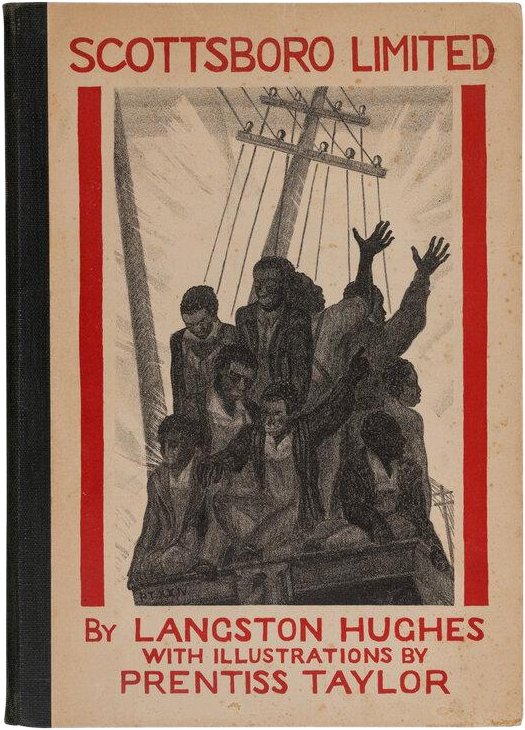
Hughes’s 1937 poem “Roar, China!” stages a striking juxtaposition: it places China’s struggle against foreign domination alongside the United States’ Jim Crow order, collapsing distance into a single sensory map of power. The poem calls to “Smash the revolving doors of the Jim Crow Y.M.C.A.s. . . . Stand up and roar, China!” (Gao, ch. 5). This coupling invites readers to perceive Afro‑Asian oppression as structurally connected and to experience a shared claim to visibility and audibility across borders.
Hybridity functions as a sensory reprogramming. By adapting Chinese revolutionary signs to Black political aesthetics, Hughes makes each tradition witness and amplify the other, an act through which a cross‑racial perceptible community comes into being.
3.4Summary of the Theoretical Framework
The N–P–H model is not a linear process, but rather a dynamic system in motion. In reality, negotiation, productivity, and hybridity often intertwine, and each stage may face resistance and compression from power structures. However, this model allows us to clarify how the practices of specific artists unfold across different sensory domains and generate new political aesthetics through cross-cultural translation.
In the next sections, this study will analyze Robeson’s acoustic politics (Negotiation), the Black Panther Party’s reproduction of Chinese revolutionary visual symbols (Productivity), and Hughes’s spiritual hybridity (Hybridity), revealing how these practices collectively form a “sensory liberation chain” and leave a lasting political legacy within the transpacific artistic network.
4Case Studies: Three Practices of Sensory Reconstruction
4.1Negotiation / Acoustic Politics: Paul Robeson and “March of the Volunteers”
4.1.1Historical and Political Context
Paul Robeson (1898–1976) was not only one of the most acclaimed bass-baritone singers and actors of the twentieth century but also a figure who constantly fused art with politics. His early successes on Broadway and London’s West End soon made him an international star. This visibility gave him a unique platform to bring Black spirituals, workers’ songs, and revolutionary anthems to audiences from the Soviet Union to China.
Robeson always treated performance as political. He insisted that artists must stand with the people, not above them. As Duberman cites him saying during the Spanish Civil War: “It is dishonorable to put yourself on a plane above the masses. As an artist I come to you; I am one of you” (Duberman 261). This statement reveals his conviction that art was not neutral but a weapon in anti-fascist and anti-colonial struggle.
With the onset of the Cold War, the U.S. political climate hardened. Under McCarthyism, Robeson’s internationalism and ties to the Soviet Union and China made him a prime target. In 1950, the State Department revoked his passport, cutting him off from international stages. As Shana L. Redmond explains, “The first is his passport revocation . . . [1950–1958] . . . effectively ended the superstar stage of his career, killed his music industry recording opportunities, and isolated him . . . He simply would not be kept from his communities” (Redmond 8).
Duberman confirms that Robeson denounced the action as nothing less than silencing: “Robeson himself denounced the passport action as one more attempt by the Truman administration ‘to silence the protests of the Negro people’—but his statement was not widely carried in the press” (387).
Yet Robeson refused to be muted. As Redmond observes, he would not be kept from his communities. Instead, he invented new techniques of listening and for being heard. In the years of passport revocation and media restriction, he continued to perform domestically, record, and work through peace networks and allies abroad. This persistence itself was a political act—an insistence on reclaiming the right to be heard.
4.1.2The Cross-Cultural Negotiation of Sound
Amid early Cold War repression and racialized listening in the United States, Paul Robeson chose to carry “March of the Volunteers” (“Chee Lai!”) onto American and international stages, turning a Chinese wartime anthem into a multilingual, cross-border public event. His collaboration with Liu Liangmo began with attentive listening and notation. At New York’s City College stadium, “he announced, ‘I am going to sing a Chinese fighting song, called “Chee Lai!”’ . . . he sang in perfect Chinese; the audience demanded an encore” (Gao, ch. 2).
He then scaled up the song’s reach. At Washington’s Union Square and New York’s Madison Square Garden, Robeson stood “shoulder to shoulder with Liu and performers of the Chinese People’s Chorus,” singing “‘Chee Lai!’ in both Chinese and English” (Gao, ch. 2). To embed the anthem in everyday listening, Robeson, Liu, and the Chorus recorded Chee Lai! Songs of New China (Keynote, 1941) with the clear aim that “the record [be] played on radio stations and in homes around the United States” (Gao, ch. 2). The sound then traveled further: “Hollywood eventually adopted ‘Chee Lai!’ . . . The U.S. Army Air Force Orchestra played the tune at the start and conclusion of the film Why We Fight: The Battle of China (1944)” (Gao, ch. 2).
Within this frame, Robeson’s triad of Chinese lyrics, bass timbre, and mass media redistributed audibility. Live performance unsettled Anglophone dominance, stadiums and squares created collective listening spaces, and records, radio, and film extended the reach of revolutionary sound. Within an unequal political and cultural order, he used cross-linguistic performance and circulation to compel audiences to confront voices from the margins, which greatly exemplified the meaning of negotiation. This fleeting “acoustic displacement” was a direct claim and rewriting of the right to be heard.
This is a clear example of “negotiation” in the N–P–H model: strategically using voice and language to contest the right to be heard in an unequal power structure, displacing the existing racialized auditory order, if only momentarily.
4.2Productivity / The Black Panther Party’s Reproduction of Chinese Revolutionary Visual Symbols
4.2.1Visual Production: Historical and Political Background
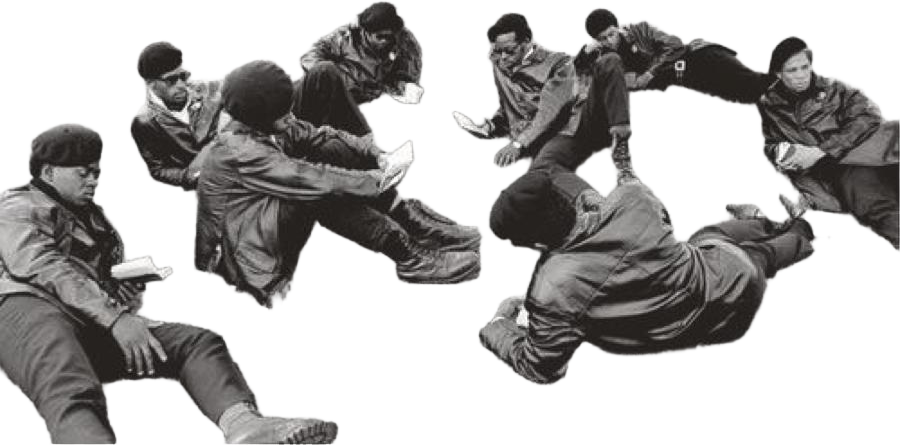
In the 1960s and 70s, the Black Panther Party answered state violence with armed self-defense, but it also treated culture as a central front. The Party’s newspaper, The Black Panther, was the key instrument because it fused political ideas with a visual language. Huey P. Newton set a clear cultural rule—“the only real culture is revolutionary culture” (Seale)—so images, slogans, and layout worked for mobilization. The paper also sustained the Party materially: “One of the main sources of funds is the Party’s newspapers. It is an organ which lumpen proletarian brothers and sisters produce” (Seale). Readers were not passive: “A large portion of our money comes from many groups and people . . . who sympathize with the Party because they have taken time to read our newspaper” (Seale). These lines make “cultural production” concrete: the paper placed Black communities into public visibility and tied the organization to its base.
At the same time, the Panthers brought Chinese revolutionary culture into U.S. streets and turned it into a workable visual material tactic. The strongest example is the “Red Books for Guns” drive. Seale records Huey’s idea: “We can make some money to buy some guns . . . We can sell those Red Books” (Seale). They framed it literally as “Dollars for Red Books.” At Berkeley’s gate, Huey turned text into a public spectacle: “Power comes out of the barrel of a gun. Quotations from Chairman Mao Tsetung. Get your Red Book” (Seale). The outcome was immediate: “We sold the Red Books inside of an hour . . . the next thing I knew, we had enough money to buy two shotguns” (Seale). This method made a small red book into a street icon and translated anti-imperialist discourse into a handheld visual object. It shows how the Party’s cultural and revolutionary significance lay in making politics visible: connecting public imagery and resource mobilization, while embedding Chinese elements within the graphic vocabulary of Black liberation.
4.2.2Producing the “Right to Be Seen”
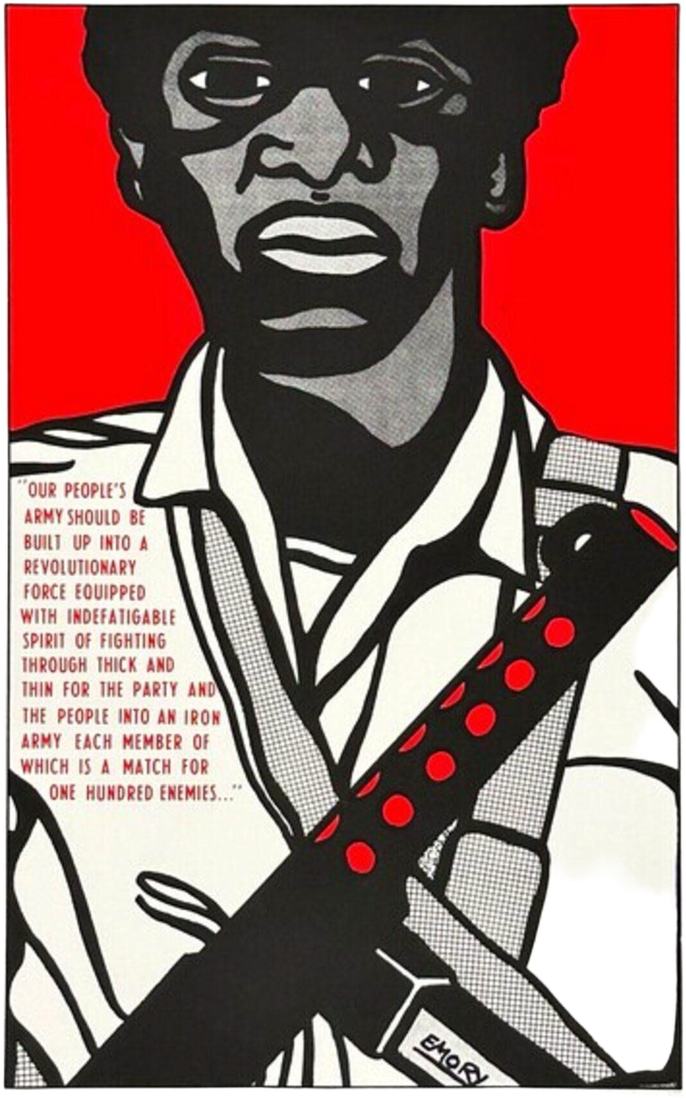
In the late 1960s and early 1970s, The Black Panther used layout as a visual instrument to produce political visibility. Methodologically, the Party’s pages resonated with Mao-era China: both treated images as “conduits of values and political culture” (Gaiter 90). This helps explain the paper’s heavy reliance on illustration and poster-like spreads, since, as Huey P. Newton put it, “The black community is basically not a reading community . . . but learns through observation of or participation in [an] activity” (Gaiter 90). The Panthers thus translated Maoist visual grammar (high-contrast black/white/red, slogan-like text, massed figures) into the U.S. context, and circulated their own claims outward; the paper “was shipped to locations all over the world, including China” (Gaiter 96). Emory Douglas’s bold line-work often “alluded to prototypical simple black, white, and red Maoist posters,” refitting Third World revolutionary directness into a street-readable Black liberation language (Gaiter 96). Together these practices carved out visibility within a racialized visual order.
A distinctive proof is the cover of 16 March 1969: a near full-page portrait of Mao with the caption, “Without a People’s Army, the People Have Nothing.” The image was black and white, overlaid by a “bright red transparent” field—“Chinese red”—with a collaged “army of young people with rifles raised.” The back cover enlarged the same background, the red overlay signifying “Red China,” the Cold War enemy of the U.S. but “the friend of international revolutionaries” (Gaiter 96). Rather than mere borrowing, the page recomposed Chinese revolutionary tropes with Panther narratives of self-defense, mobilization, and internationalism. Hence, “The Black Panther cover image communicates solidarity between Chairman Mao and the BPP” (Gaiter 97). In the same vein, Douglas “deliberately presented everyday people as heroes,” shifting the scale of heroism from leader-images to ordinary Black men and women—so readers weekly encountered themselves as historical actors (Gaiter 102).
This case demonstrates productivity within the N–P–H framework, which uses media and design to generate a new system of meaning that inserts transpacific signs into a local political scene to contest and expand the right to be seen.
4.3Hybridity / Spiritual Hybridity: Langston Hughes’s Chinese Poetry
4.3.1The Internationalist Poet
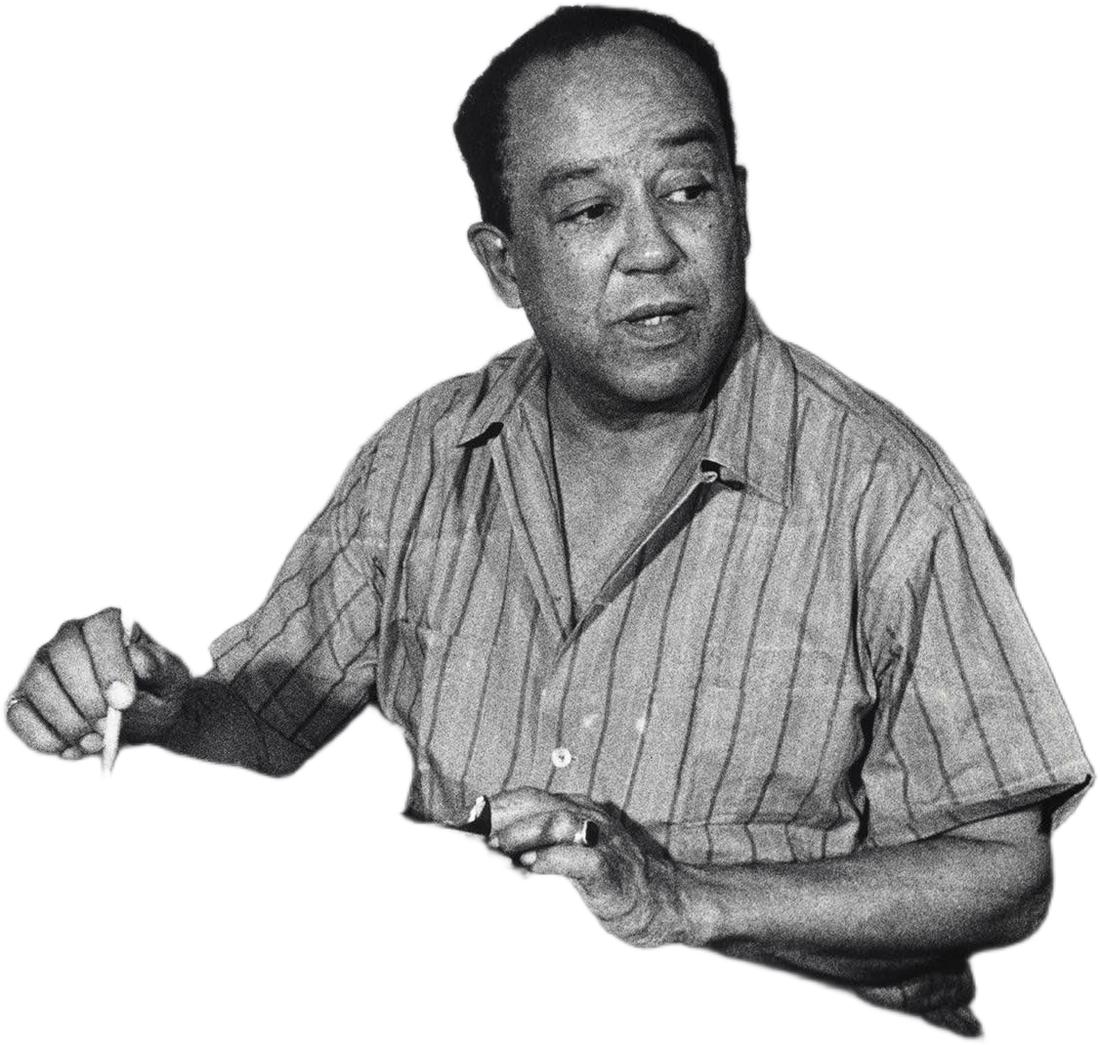
Langston Hughes emerges here not only as a major Black American poet with a global outlook but as a writer who linked struggles across continents through travel, friendship, and art. As he once said,
For the last 20 years, half writer and half vagabond, I have traveled from here to yonder around and back again, up and down the African coast, through Russia, through Asia, back and forth across America and, in general, from pillar to post. (Hughes, Big Sea 20)
His internationalism was deliberate. In an unpublished draft of his second autobiography, he wrote that his ambition was “to visit all the dark countries of the world, all those lands where live Negroes or Asiatics. Being an American Negro who grew up in a country predominantly white, it always intrigued me to look into lands predominantly colored” (Hughes, Big Sea 15). Early on, he forged ties with Chinese peers. At Columbia he was “closest to a Chinese fellow from Honolulu, Yee Sing Chun, who took him to Chinatown and passed on a smattering of Mandarin,” and at that time “Hughes adopted a Chinese pen name, LangHu (or Langhu)” (Hughes, Big Sea 53).
In 1933 he traveled to China and “would see realities that ran counter to the racialized caricatures widely propagated through the American popular media,” an experience that broadened his Black internationalist frame (Lai-Henderson 89). This encounter fed directly into his writing, as seen in poems like “Good Morning, Revolution” (1932), “One More S in the U.S.A.” (1934), “Roar, China!” (1937), and “Ballad of Lenin” (1938), which, as Lai-Henderson notes, “reflect his advocacy for the kind of democratic ideals that aimed to connect colonial populations and working classes across the globe” (90). The influence of this experience persisted, since “despite the brevity of Hughes’s sojourn, China continued to inform his black internationalist position in the African American literary community until his passing” (Lai-Henderson 91).
4.3.2The Trans-oceanic Imagery in “Roar, China!”
On August 29, 1937, Langston Hughes wrote “Roar, China!” a passionate call for China to resist Japanese invasion. He urged with great intensity:
Roar, China!
Roar, old lion of the East!
. . . . . . . . . . . .
Break the chains of the East,
Little coolie boy!
Break the chains of the East,
Red generals!
Break the chains of the East,
Child slaves in the factories!
Smash the iron gates of the Concessions!
Smash the pious doors of the missionary houses!
Smash the revolving doors of the Jim Crow Y.M.C.A.s.
Crush the enemies of land and bread and freedom!
Stand up and roar, China! (Hughes, “Roar, China!” 198–200)
The most striking artistic device in the poem is montage. Hughes juxtaposes different historical scenes to create a cross-national vision. For example, he links the violence of imperialist powers in China with racial segregation in the United States: “Smash the revolving doors of the Jim Crow Y.M.C.A.s” alongside “Smash the iron gates of the Concessions” (Gao, ch. 5). Through montage, he weaves together China’s colonial humiliation and African American oppression into a single revolutionary cry.
The poem’s emotional power lies in its universal solidarity. Hughes’s poetry “uses the imagined ‘Chinese’ metonym to globalize his own particular experience as an African American within the United States context and to link it to the then-contemporary experience of a Chinese revolutionary reality” (Lai-Henderson 91). This cultural hybridity makes China and African Americans part of the same historical current, both shouting “Roar!” as one.
“Roar, China!” was not an isolated work. Throughout the 1930s and 1940s, Hughes continued to insert China into his writings. From “Song of the Refugee Road” (1940) to “Consider Me” (1951–52) to “Birmingham Sunday” (1963), China reappeared as a bridge linking Black literature and global revolution (Lai-Henderson 91). As Gao notes, “The feelings Hughes expressed in ‘Roar, China!’ about China’s glories, ancient history, recent humiliation, the rise of the Chinese Communist Party, and the imperative for China to ‘roar’ at this critical historical moment were taken up by W. E. B. Du Bois in his 1959 poem ‘I Sing to China’” (Gao, ch. 5). Thus, “Roar, China!” was not only a response to a moment of war, but also a vital node in the larger currents of Black internationalism across the Atlantic and Pacific.
Hughes’s poem is a powerful example of the “hybridity” concept, symbolically linking the struggles of oppressed people across distant lands. It creates a “third space” where Black Americans and Chinese revolutionaries could find solidarity and a shared political struggle, demonstrating how cultural hybridity forms new spaces for political imagination and collective action.
5Power Backlash and the Struggle of Sensory Politics
Yet the practice of transpacific sensory politics was not a one-dimensional path to victory. As Rancière reminds us, any redistribution of the sensible inevitably triggers a backlash from power structures; and Bhabha’s “Third Space” is not always a stable refuge, but a space that can contract, assimilate, or even be destroyed under political pressure. This section focuses on the three case studies in section 4, analyzing how these artists encountered power backlash at different stages and how these resistances affected the sensory liberation chain.
5.1Negotiation Tension: The Denial of the “Right to Be Heard”
Amid Cold War repression and a racialized listening order, Paul Robeson’s art–politics repeatedly collided with state power. He was not a symbolic “internationalist” in the abstract but a practitioner who used voice to link anti-imperial struggles abroad with anti-racist struggles at home. In August 1950, the U.S. government took a decisive step—“in response to FBI demands, the State Department voided Paul Robeson’s passport and informed customs agents that they were ‘to endeavor to prevent his departure from the United States’ should he attempt to leave’” (Gao, ch. 2). This was not an isolated administrative act but part of an institutional architecture that curtailed audibility. Robeson kept accepting international invitations to keep his case and his right to be heard. For him it was “‘especially bitter in this case’ . . . because of his deep concern for the world peace movement and his long-felt ‘close kinship with the Chinese people’” (Gao, ch. 2). Chinese coverage made the silencing visible as social fact: “people cannot hear Robeson anymore. Hosts of major concerts pretend that he does not exist, officials lock up city halls upon hints of his planned presence at public gatherings, Hollywood is too scared to touch him, and those who had followed him closely for autographs step aside to give way to the FBI investigators” (Gao, ch. 2).
From the U.S. side, Duberman details the routinized surveillance that fenced off Robeson’s public voice, such as “having his mail intercepted, his phone conversations bugged, his public appearances monitored and reported” (ch. 21). In 1955 the passport fight hit another wall: “The application was immediately denied; Robeson was again told he had to sign a ‘non-Communist’ affidavit before a passport for him could even be considered” (Duberman, ch. 21). Robeson read this as a targeted gag on Black protest, “one more attempt by the Truman administration ‘to silence the protests of the Negro people’” (Duberman, ch. 19). Taken together, these statements show how policy, policing, and media protocols synchronized to strip him of public audibility.
5.2Productivity Tension: The Denial of the “Right to Be Seen”
In 1968, the FBI broadened COINTELPRO program against “black nationalist” organizations and spelled out long-term aims. One directive was to “prevent militant black nationalist groups and leaders from gaining respectability, by discrediting them to three separate segments of the community,” and another was “to prevent the long-range growth of militant black nationalist organizations, especially among youth” (Bloom and Martin 202). As the Panthers’ influence grew, a September 1968 internal memo sharpened tactics:
The extremist [Black Panther Party] of Oakland, California, is rapidly expanding . . . [It] is essential that we not only accelerate our investigations . . . but that we take action under the counterintelligence program to disrupt the group. (Bloom and Martin 203)
The program’s logic targeted the Party’s ability to be seen and heard in public, aiming “to keep this group isolated from the moderate black and white community which may support it” (Bloom and Martin 211).
On the ground, repression combined disinformation, surveillance, infiltration, and lethal force. As Bloom and Martin summarize: “They fed defamatory stories to the press. They wiretapped Panther offices around the country. They hired dozens of informants to infiltrate Panther chapters” (Bloom and Martin 6). Navid Farnia’s review-essay underscores the scale: COINTELPRO “targeted the BPP more than any other organization,” and records “indicate that the FBI initiated 233 formal counterintelligence actions against the BPP out of the 295 deployed against Black nationalist groups,” all within a wider climate that “successfully isolated the Panthers” and used “brute force and constant pressure” to drive the Party to extinction (173). Read together, these sources show a coordinated effort to fracture alliances, discredit leaders, and suppress the Panthers’ cultural-political visibility—precisely the terrain where the Party had been most productive in creating new visual and sonic languages.
5.3Hybridity Tension: The Fragility of Hybridity
From the late 1940s into the early 1950s, Hughes’s internationalist poetry was drawn into McCarthyite scrutiny. In 1953 he was summoned before HUAC, “a hearing that was televised across the nation, although even the FBI admitted that he had never been a communist” (Gao, ch. 5). His poems, especially those touching on China and the Soviet Union, were interrogated line by line. Under pressure he admitted to a “reorientation” of thought. This encounter pushed him into greater caution and self-censorship. Yet as Lai-Henderson stresses, “McCarthyism had a profound impact on how Hughes articulated his political thoughts thereafter, but it did little to stop him from using the powerful tool of internationalism as he continued to address the crises of racism and racial hegemony at home and abroad” (99–100). In other words, his rhetoric shifted from direct slogans to metaphor and symbol, but the framework of international solidarity remained.
This shift is vivid in his poetry. In “Roar, China!” (1937), he called forth a fire-breathing dragon, aligning China with global anti-fascism. By 1963, in his short poem “China,” the image became a caged lion: “and looks out on a narrow world— / But is not blind” (Lai-Henderson 102). The change showed hybridity’s contraction, from blunt mobilization into symbolic resistance. As Gao observes, “Hughes’s suppressed inspiration drawn from the CCP resurfaced in fury at the brutal racial violence African Americans suffered” (ch. 5). Even under Cold War scrutiny, he continued to link the symbolic power of Chinese revolution with African American struggles. Hybridity did not vanish; it survived in allegory, sustaining a trans-racial community of feeling through more cautious expression.
5.4Conclusion: The Double Cycle of Sensory Politics
Reviewing the three cases reveals how power persistently narrowed the spaces of being heard, being seen, and being sensed together. Paul Robeson, stripped of his passport and silenced through FBI surveillance, lost his ability to carry his voice across borders, embodying the deprivation of the voice. The Black Panther Party’s creative visual production met the full force of COINTELPRO, which smeared, infiltrated, and raided its networks, cutting off its right to be seen in public culture. Langston Hughes, after HUAC hearings, shifted from direct revolutionary slogans to allegory and symbol; under McCarthyism, the hybrid “third space” contracted, showing the vulnerability of cross-cultural commons.
Politics operates not only in institutions and force but also in the ordering of the senses. African American artists, through cultural translation and hybrid aesthetics, sought to redistribute the sensible, creating new events of sound and image, while the state worked to reseal those cracks through surveillance, repression, and stigmatization, simultaneously attesting the power of such sensory politics.
Yet even under pressure, these practices left open an alternative common. They did not overturn the system but preserved other ways of being audible and visible for marginalized groups. This residual sensory community became a resource for imagining transnational solidarity and future cultural politics.
6Conclusion
This study has shown that the transpacific circulation of Chinese revolutionary imagery and sounds between the 1930s and the 1970s was never a matter of simple ideological importation. Rather, it functioned as a set of sensory resources that African American artists actively translated into practices aimed at remaking who could be heard and who could be seen. At the center of this analysis is the N–P–H model—Negotiation, Productivity, Hybridity—which frames how artists intervened in the racialized “distribution of the sensible” to claim auditory and visual presence, produce new public grammars, and construct third spaces that braided distinct political vocabularies. This framework synthesizes the study’s theoretical and empirical work and foregrounds the politics of sensory rights as an axis for understanding cross-cultural creativity and repression.
Taken together, the three case studies reveal a recurrent dynamic: creative efforts to expand new sensory possibilities and institutional attempts to restrict them continually collided, creating an ongoing struggle over public perception. Paul Robeson’s multilingual performances converted linguistic and sonic “noise” into a political address that momentarily unsettled American listening regimes, but constrained by passport suspensions and surveillance. The Black Panther Party translated Maoist visual vocabularies into street-readable formats that made political dignity legible, but targeted by COINTELPRO and media. Langston Hughes reworked transoceanic poetic imaginations into a hybrid rhetoric of solidarity that survived under the pressures of HUAC and cultural containment. Each case thus demonstrates how the struggle for the right to be heard, the right to be seen, and the ability to imagine a shared public sense was pursued through distinct sensory registers and repeatedly contested by state and institutional power.
This legacy is not confined to the past. It continues to play out in new forms today. The contemporary resonance of these historical dynamics is made plain by the Amy Sherald episode. In July 2025, Sherald announced she would cancel her planned National Portrait Gallery show after disputes arose over her portrait Trans Forming Liberty (2024), a depiction of a trans woman that the artist said the museum had expressed concern about including. According to Sherald, institutional fear, shaped by a hostile political climate toward trans lives, played a role in discussions that might have led to removal. Sherald also reported that the Smithsonian planned to present a video of people reacting to the painting, a curatorial move she opposed because it would have reframed the work as an object for debate rather than as an unmediated claim to presence (Blair). That the dispute unfolded in the shadow of recent institutional pressures further highlights how external political climates and institutional pressure constrain museums’ capacities to uphold artists’ claims to visibility.
This event mirrors the struggles over sensory space that African American artists fought in the mid-20th century. Sherald’s decision should be read as a present-day instance of the “distribution of the sensible” I trace historically: efforts to expand who may appear in public and how they appear are continually met by institutional anxieties and political pressures that seek to contain or reframe those appearances. It parallels Robeson’s acoustic politics, as Sherald’s painting challenges the exclusionary mechanisms of visual order; it echoes the Black Panther Party’s visual production, as it too sought to create new “ways of being seen” for marginalized groups through symbolic imagery and cross-cultural elements but faced institutional limits; and it resonates with Hughes’s poetic vision, as her artwork attempts to connect the shared experiences of marginalized groups through symbolism and imagery.
From Hughes’s poetic imaginations to the Black Panther Party’s transformation of Chinese revolutionary imagery into a political language of Black liberation, and Robeson’s voice breaking through Cold War auditory blockades, these artists collectively expanded Black presence in the public sensory space. Sherald’s exhibition withdrawal reminds us that public spaces must protect the rights to be seen and heard, especially when those rights belong to groups whose sensory presence is most often erased by the sensory order.
The transpacific politics of the senses that influenced mid-century African American engagements with Chinese revolutionary forms were never merely aesthetic experiments; they were insurgent claims on public life, acts of reconfiguring who could be heard, who could be seen, and what could be imagined. Such claims had to be remade continually under shifting regimes of censorship, surveillance, and containment. Yet they carved out fragile openings where new forms of solidarity could be sensed and enacted.
To honor that legacy today is not only to recognize its historical significance but also to insist that cultural institutions and publics confront the political stakes of visibility and audibility. Preserving these conditions means defending the possibility of creating “third spaces,” where suppressed voices can resonate, contested images can circulate, and the work of sensory liberation persists as an unfinished yet enduring project within contemporary cultural and political life.
Bibliography
- Bhabha, Homi K. The Location of Culture. Routledge, 2004.
- Blair, Elizabeth. “Artist Amy Sherald Has Canceled Her Upcoming Show at the Smithsonian.” NPR, 24 July 2025, www.npr.org/2025/07/24/nx-s1-5479078/artist-amy-sherald-has-canceled-her-upcoming-show-at-the-smithsonian.
- Bloom, Joshua, and Waldo E. Martin. Black Against Empire: The History and Politics of the Black Panther Party. U of California P, 2013.
- Duberman, Martin B. Paul Robeson. New Press, 1989.
- Farnia, Navid. “State Repression and the Black Panther Party: Analyzing Joshua Bloom and Waldo E. Martin’s Black Against Empire.” Journal of African American Studies, vol. 21, no. 1, 2017, pp. 172–79, doi.org/10.1007/s12111-017-9343-y.
- Gaiter, Colette. “The Black Panther Newspaper and Revolutionary Aesthetics.” Art, Global Maoism and the Chinese Cultural Revolution, edited by Jacopo Galimberti et al., Manchester UP, 2019.
- Gao, Yunxiang. Arise, Africa! Roar, China! Black and Chinese Citizens of the World in the Twentieth Century. U of North Carolina P, 2021.
- Hartman, Saidiya V. Scenes of Subjection: Terror, Slavery, and Self-Making in Nineteenth-Century America. Rev. and updated ed., W. W. Norton, 2022.
- Howard, Joshua H., and Frederick Lau. Composing for the Revolution: Nie Er and China’s Sonic Nationalism. U of Hawaii P, 2020.
- Hughes, Langston. “Roar, China!” The Collected Poems of Langston Hughes, edited by Arnold Rampersad and David Roessel, Alfred A. Knopf, 1994, pp. 198–200.
- Hughes, Langston. The Big Sea: An Autobiography. 1940. Hill and Wang, 1993.
- Jeffries, Judson L. Review of Black Against Empire: The History and Politics of the Black Panther Party, by Joshua Bloom and Waldo E. Martin Jr. Spectrum: A Journal on Black Men, vol. 5, no. 1, 2016, pp. 177–84, doi.org/10.2979/spectrum.5.1.12.
- Kelley, Robin D. G., and Betsy Esch. “Black Like Mao: Red China and Black Revolution.” Afro Asia: Revolutionary Political and Cultural Connections Between African Americans and Asian Americans, edited by Fred Ho and Bill V. Mullen, Duke UP, 2008.
- Lai-Henderson, Selina. “Color Around the Globe: Langston Hughes and Black Internationalism in China.” MELUS, vol. 45, no. 2, 2020, pp. 88–107.
- Pereira, Allan Kardec da Silva. “De-Romanticizing the History of Slavery in the United States: The Tragic Mode in Saidiya Hartman’s Scenes of Subjection.” Varia Historia, vol. 40, 2024, e24025, doi.org/10.1590/0104-87752024v40e24025.
- Rancière, Jacques. The Politics of Aesthetics: The Distribution of the Sensible. Translated by Gabriel Rockhill, Continuum, 2004.
- Redmond, Shana L. Everything Man: The Form and Function of Paul Robeson. Duke UP, 2020.
- Seale, Bobby. Seize the Time. Hutchinson, 1970.
- Stoever, Jennifer Lynn. The Sonic Color Line: Race and the Cultural Politics of Listening. New York UP, 2016.
- Terrell, Robert L. “The First 25 Years of the Beijing Review, an Official Propaganda Organ of the Communist Party of the People’s Republic of China.” Gazette, vol. 37, no. 3, 1986, pp. 191–219.
- Wilcox, Emily. “When Folk Dance Was Radical: Cold War Yangge, World Youth Festivals, and Overseas Chinese Leftist Culture in the 1950s and 1960s.” China Perspectives, no. 1, 2020, pp. 33–42.
End of essay · NOUS Review